
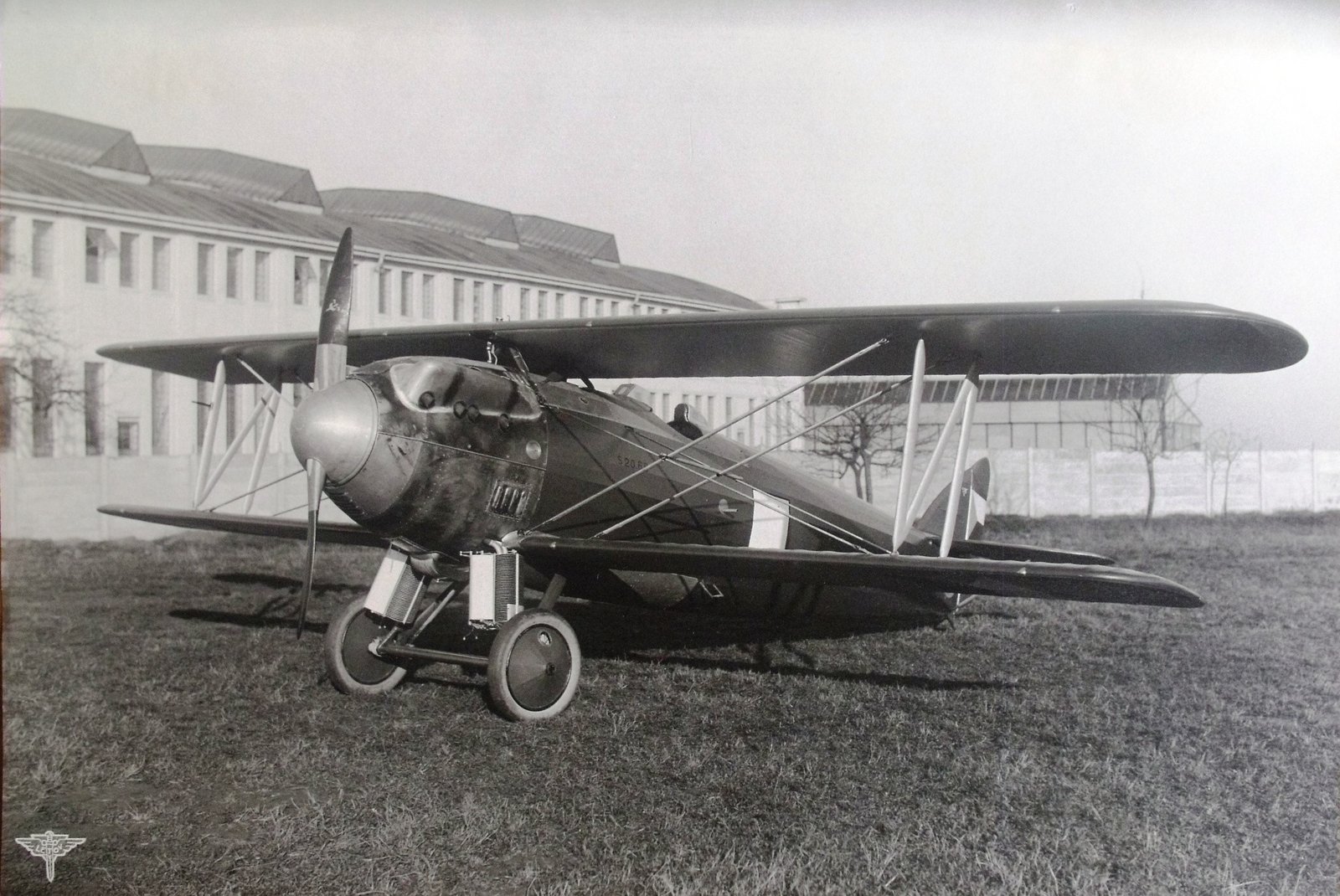
The Letov Š-20 (also styled as the S-20 or Š.20) was a single-seat biplane fighter produced in Czechoslovakia during the 1920s. Designed by Alois Šmolík, the aircraft served as a standard fighter for the Czechoslovak Air Force during the interwar period. The prototype first flew in 1925, following the development of the precursor Letov Š-14 in 1924. The aircraft featured a conventional single-bay biplane configuration with unstaggered wings braced by N-struts. Its construction was mixed, utilizing a fabric-covered welded steel-tube fuselage and empennage, while the wings employed a tubular metal spar with wooden and fabric skinning.
Production took place at Letov facilities in Prague, including sites in Holešovice and later Kbely and Letňany. The manufacturer, Letov, was the oldest aircraft manufacturer in the region and the first Czechoslovak aviation company, having evolved from state-run repair facilities founded in 1918. Total production is estimated between 114 and 120 aircraft, including prototypes. The Czechoslovak Air Force acquired 105 units, primarily the Š-20M variant. Additionally, Lithuania purchased between 8 and 10 aircraft as the Š-20L variant, which featured an interchangeable ski undercarriage. A single unarmed advanced trainer prototype, designated the Š-21, was also constructed but did not enter series production.
The primary powerplant for the Š-20M was the Hispano-Suiza 8Fb, a liquid-cooled V-8 piston engine. While designed in France, the engine was produced under license in Czechoslovakia by Škoda starting in 1922, delivering 300 hp. A separate variant, the Š-20J, utilized a 9-cylinder air-cooled Walter Jupiter radial engine. In terms of armament, the fighter was equipped with two synchronized 7.7 mm Vickers machine guns (ZB vz.09 or Vickers vz. 09) mounted in the forward fuselage, each with 400 rounds of ammunition.
Performance metrics for the Š-20M included a maximum speed of 256 km/h and a cruise speed of approximately 226 km/h. It possessed a service ceiling of 7,200 m, a range of 500 km, and a rate of climb of 360 m/min. The type achieved notable success in national air racing, winning its category in the 1926 President of the Republic air race with a speed of 234 km/h.
While primarily a military aircraft, some demilitarized examples were used by private pilots and flying clubs. One such aircraft, registered as OK-LEO and painted deep red, was operated by the Hanácký flying club in Olomouc from 1934 to 1937. The Š-20 remained in Czechoslovak service until 1936 and Lithuanian service until 1935. Today, a preserved example is displayed at the Letecké Muzeum Kbely in Prague.