
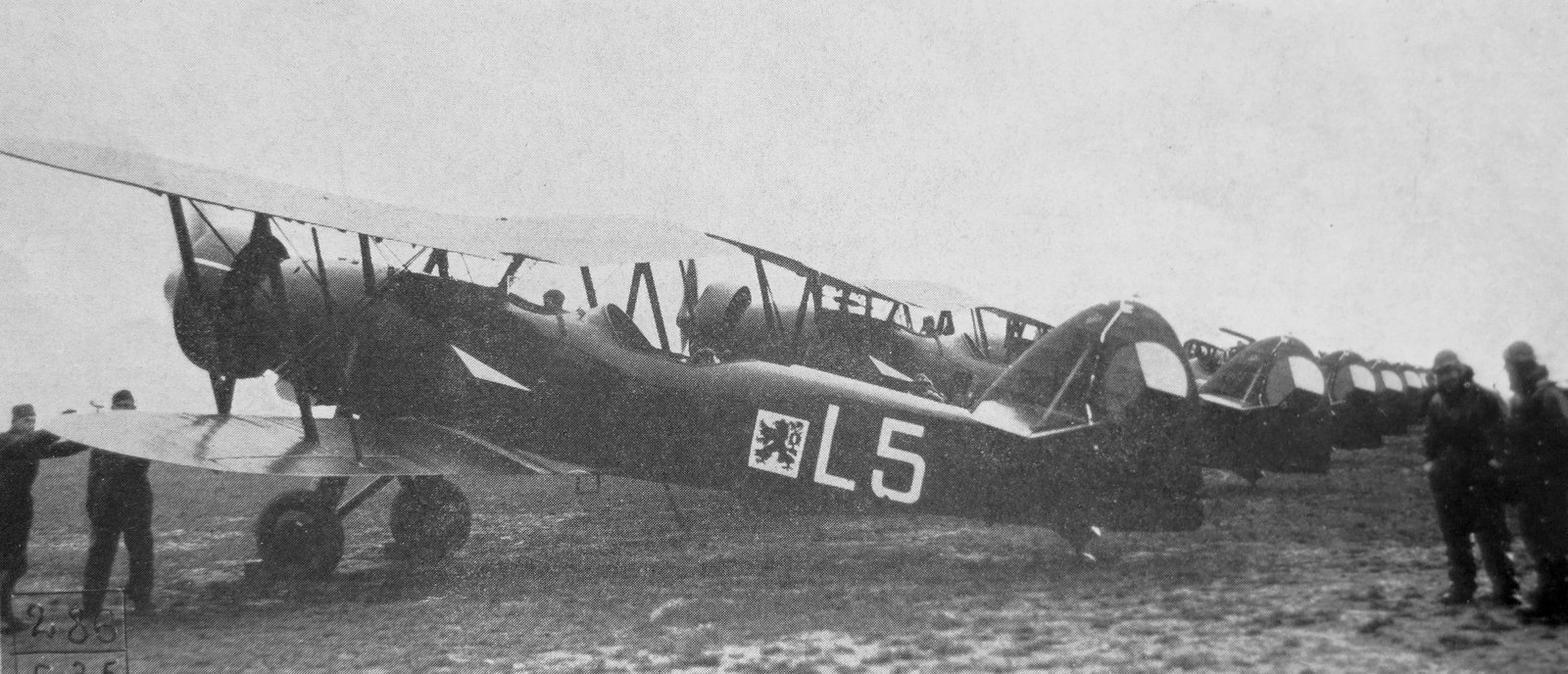
The Letov Š-28 family, most notably the Š-328 production variant, was developed by the Letov Kbely aircraft works in Czechoslovakia to replace the earlier Letov Š-16. Designed under the leadership of chief designer Alois Šmolík, the original Š-28 prototype first flew in 1929. While the prototype did not lead to immediate series production, design work began around 1932 to meet requirements from the Finnish Air Force, resulting in the Š-328, which first flew in 1934 and entered service with the Czechoslovak Air Force in 1935.
Production of the Š-28 family took place at the Kbely airfield near Prague. While production dates vary by source, the main series production spanned approximately 1934 to 1940. This included the Š-128 (12 built) and the Š-228 (4 built for Estonia). The primary production subtype, the Š-328, saw 412 aircraft manufactured. Even after the German occupation of Czechoslovakia in March 1939, production continued at the Kbely plant, with the final batches consisting of 30 aircraft for Bulgaria and 50 for the Luftwaffe and Slovak Air Force.
The aircraft was designed for multi-role versatility, serving as a reconnaissance aircraft, light bomber, and ground-attack platform. It featured a two-bay biplane design with fixed landing gear and could carry up to 500 kg of bombs. Armament typically included two fixed forward-firing 7.92 mm vz.30 machine guns and two flexible vz.30s in the rear cockpit. A specialized night-fighter variant, the Š-328N, was tested with four wing-mounted machine guns, though these were later reverted to standard configuration due to a lack of radar.
Engine configurations varied across the family. The 1929 prototype used a 176 kW Walter Castor I radial. Production versions utilized various radial engines, including the Bristol Mercury VII (built by Gnome-Rhône for the Š-128 and by Walter for the Š-228) and the Walter Pegasus II-M.2, which provided 420–430 kW for the Š-328V floatplane variant. Other prototypes included the Š-328F with a 580 hp Bristol Pegasus IIM-2 and the Š-428, which featured a 740 hp Avia VR-36 V-12 liquid-cooled engine.
Operationally, the Š-328 saw extensive service. The Slovak Air Force utilized them during the 1939 invasion of Poland and Operation Barbarossa, where they performed reconnaissance and attacked Soviet vehicles. In 1944, 11 aircraft were seized by the Slovak National Uprising to fight German forces. The Luftwaffe employed captured units as trainers and night attackers on the Eastern Front during 1942–43. Additionally, the Bulgarian Air Force operated 62 aircraft (designated the 'Vrana' or 'Crow') for anti-submarine patrols over the Black Sea until 1944.