
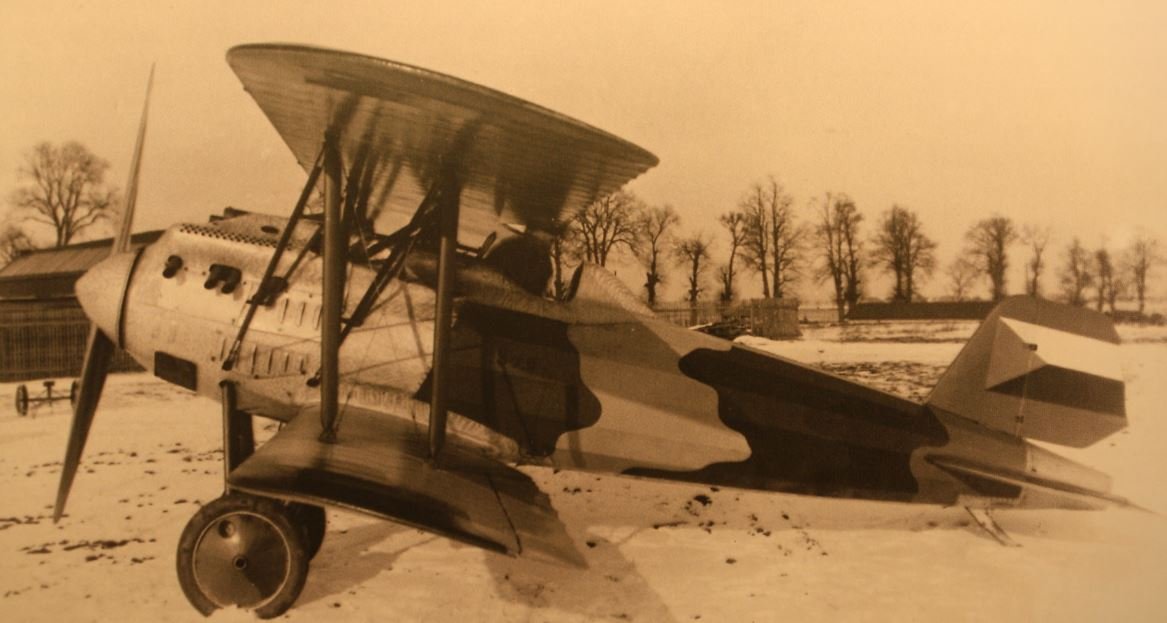
The Letov Š-7 (also referred to as the S-7 or Š.7) was a single-seat, single-engine biplane fighter prototype developed in Czechoslovakia in 1923. The aircraft was designed by Alois Šmolík, who served as the chief designer and technical director for Letov from the company's inception until 1943. The Š-7 was created specifically to enter a government competition for a new domestically produced single-engine fighter, competing against other prototypes such as the Avia BH-8 and the Aero A-20.
Constructed at the Vojenská továrna na letadla (Military Aircraft Factory) in Kbely, located in the Letňany district of Prague, the Š-7 featured a conventional single-bay biplane configuration. Its design included straight-edged constant-chord wings with blunt tips, parallel interplane struts, and a modest wing stagger. The fuselage was characterized by an oval cross-section that tapered toward the tail, and the single open cockpit was positioned partially beneath the trailing edge of the wing, which required a specific cutout. For armament, the fighter was equipped with two fixed forward-firing 7.7 mm (.303 in) machine guns, such as the Vickers vz.09, synchronized to fire through the propeller arc.
Power was provided by a 300 hp (approximately 221 kW) water-cooled V-8 Hispano-Suiza 8Fb engine, produced under license by the Škoda Works. The aircraft utilized a wooden two-bladed propeller. Initial testing revealed cooling issues related to the original ring-shaped radiator; this led to the development of the Š-7a variant, which featured a redesigned cowling and a transversely mounted ventral radiator bath. Performance data indicates a maximum speed of 255 km/h (158 mph), a climb rate of 1.5 minutes to reach 1,000 meters, and a service ceiling of 8,000 meters with a range of 580 km.
Despite these technical efforts, the Š-7 did not win the government competition and failed to secure production orders. Consequently, only one prototype was ever built, and the aircraft never entered military service or saw combat. While the Š-7 itself did not achieve operational success, it served as a stepping stone for Letov, which later produced more successful series like the Š-20 and Š-28. The manufacturer evolved from a state-established repair facility founded in 1918 into a major component producer. Today, the company exists as LATECOERE Czech Republic, a subsidiary of the French Groupe Latécoère, manufacturing parts for global aerospace leaders including Boeing and Airbus.