
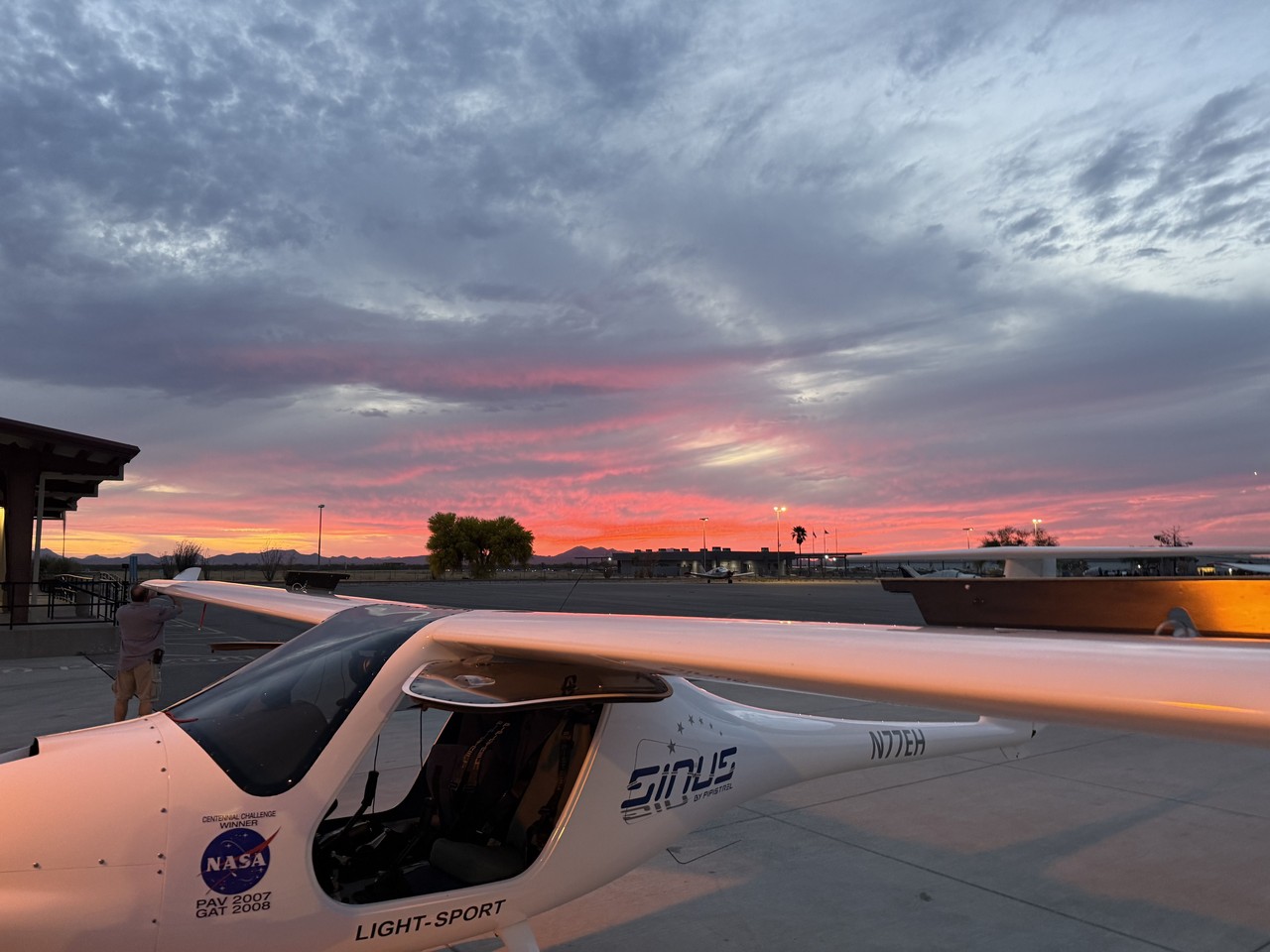
Revolutionary Composite Construction
The Sinus emerged from a collaboration between Italian aerodynamicist Franco Orlando and the Slovenian firm Albastar Ltd, with development beginning in November 1994. Orlando's innovative wing and fuselage design emphasized composite construction using fiberglass, carbon composite, and Kevlar materials. When unveiled at AERO Friedrichshafen in April 1995, the aircraft represented a significant departure from traditional ultralight construction methods. By March 2019, combined production of the Sinus and its sister aircraft the Virus had reached 1,000 units, with manufacturing facilities operating in both Slovenia and Italy.
Championship Performance
The Sinus quickly established itself as a dominant force in competitive aviation. In 2001, pilots Philippe Zen and Thomas Knowles flew a Sinus to first place in the two-seat category at the World Air Games in Spain. The aircraft claimed absolute victory at the 2001 World Air Games Championship and finished as runner-up in 2005. These competition successes demonstrated the aircraft's exceptional soaring capabilities, enabled by its variable-pitch Pipistrel VARIO propeller that could be feathered to reduce air resistance during unpowered flight.
Record-Breaking Global Flight
The Sinus achieved its most notable distinction in 2004 when Slovenian pilot Matevž Lenarčič flew a modified version around the world in 79 days, from June 6 to August 25. This historic journey marked the first time a light aircraft had completed a circumnavigation, establishing multiple FAI world records including a 500-kilometer triangle record. The achievement highlighted the aircraft's reliability and range capabilities, proving that ultralight aircraft could undertake serious long-distance missions previously reserved for conventional aircraft.
Pipistrel's Foundation and Growth
Pipistrel originated from the partnership of two sailplane pilots and model builders, Ivo Boscarol and Bojan, who began their collaboration in 1982 when Slovenia was part of Yugoslavia. Boscarol officially founded the company in Ajdovščina, Slovenia, in 1987, receiving authorization for aircraft production the same year. The company initially focused on trike aircraft before advancing to ultralight production. By 1999, with both the Sinus and Virus in production, Pipistrel was exporting to more than 30 countries. The success of these designs established Pipistrel as a major force in light aviation manufacturing.
Engine Options and Technical Innovation
The Sinus offered pilots multiple powerplant choices, all from Austrian manufacturer Rotax. Early variants utilized the Rotax 447 producing 30 kilowatts (42 horsepower), while later models could be equipped with the two-cylinder Rotax 503 (37 kW/50 HP), the more powerful Rotax 582 (48 kW/64 HP), or the four-stroke Rotax 912 delivering 60 kilowatts (80 horsepower). The aircraft's tee-tail design and cantilever wing configuration eliminated external bracing, reducing drag and improving performance. Both nosewheel and taildragger landing gear variants were available, with removable spats on all wheels except the tailwheel.
Production Milestones and Market Expansion
By April 2003, Pipistrel had manufactured 100 aircraft in the combined Sinus/Virus family, reaching the 200th aircraft milestone by March 2006 with a tri-gear Sinus 912 delivered to Taiwan. The company introduced kit versions on April 1, 2004, offering both 51 percent kits meeting FAA requirements and quick-build QBK versions to expand market accessibility. In 2021, Pipistrel signed licensing agreements with Genevation Aircraft of Hungary to extend production capabilities for Eastern European, Central Asian, African, Turkish, and Israeli markets.
Design Legacy and Continuing Impact
The Sinus design philosophy influenced numerous subsequent Pipistrel developments, including the shorter-winged Virus variant, the Apis sailplane, and advanced electric aircraft prototypes. Its emphasis on composite construction and aerodynamic efficiency established new standards for ultralight aircraft engineering. The aircraft remains in continuous production, with examples operating internationally for both recreational flying and training purposes. The Sinus proved that ultralight aircraft could achieve the performance and reliability traditionally associated with conventional general aviation aircraft, while maintaining the regulatory and operational advantages of the ultralight category.