
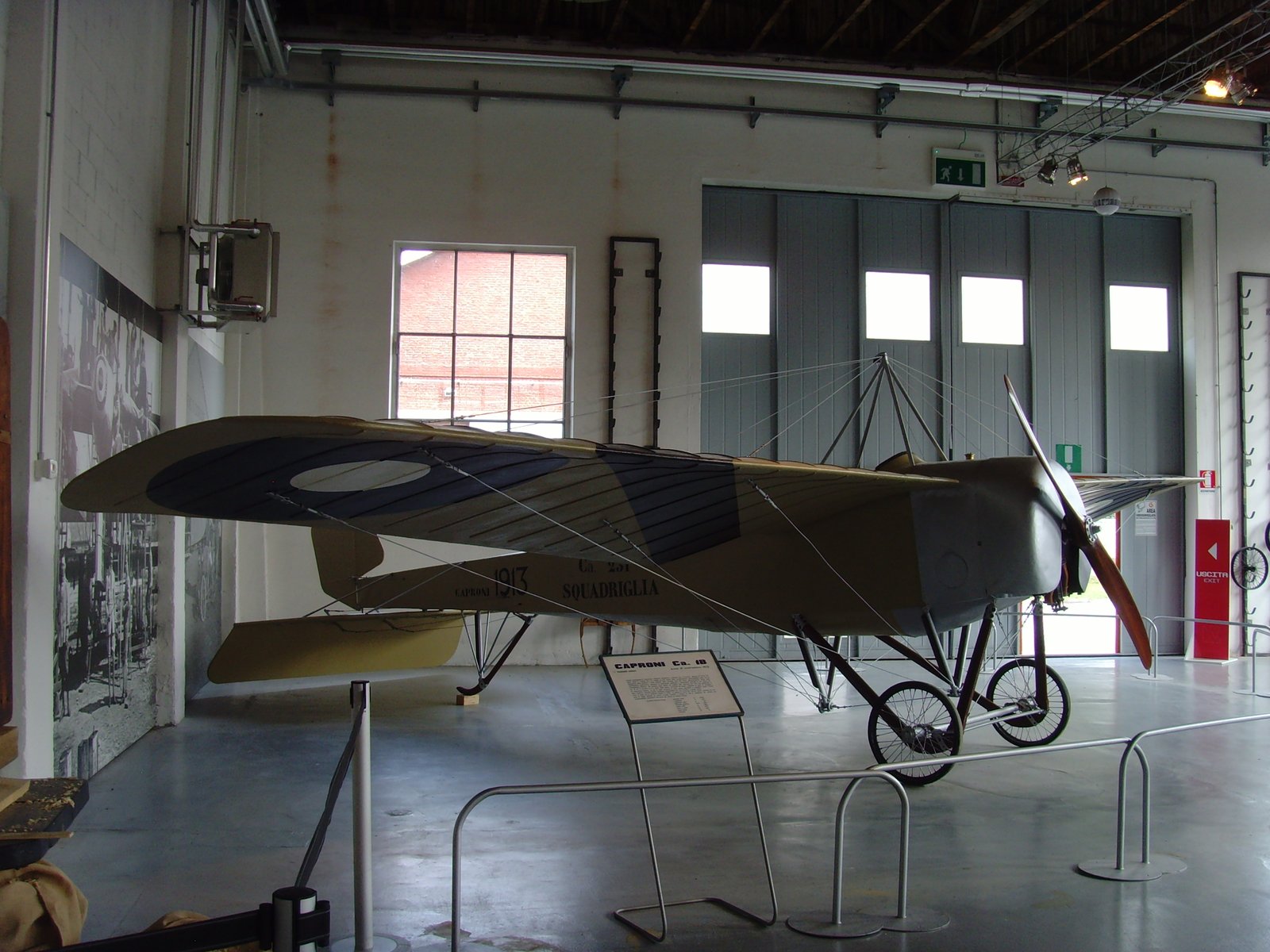
Designed by Gianni Caproni, the Ca.18 was an early 20th-century military reconnaissance monoplane that marked a significant milestone in Italian aviation history as the first indigenous aircraft to be adopted by the Italian armed forces. The aircraft was first flown in 1913, having been developed as part of a government competition held earlier that year. While the design originated in early 1913, a formal production order was not issued until after the nationalization of Caproni's company later in the year. Consequently, the aircraft entered active service in 1915, with production occurring between 1913 and 1915.
Technically, the Ca.18 was a single-engine aircraft of conventional configuration, utilizing a fixed tailskid undercarriage. A notable design feature was the implementation of bayonet fittings on the wings, which allowed the aircraft to be rapidly assembled or dismantled—a critical capability for military operations of the era. The aircraft was powered by a Gnome rotary piston engine capable of producing 60 kW (80 hp). In terms of dimensions, the monoplane had a wingspan of 10.92 meters, a length of 7.67 meters, and a height of 2.90 meters, with a total wing area of 22 square meters. The airframe was lightweight, with an empty weight of 400 kg and a gross weight of 600 kg.
Operational use of the Ca.18 was limited to a small batch of six aircraft produced for the Italian Army. These machines were assigned to the 15th Squadron and operated as part of an observation unit based at Piacenza, where they worked in conjunction with the siege artillery depot. The aircraft carried a crew of two, consisting of a pilot and an observer. In flight, the Ca.18 reached a maximum speed of 120 km/h and possessed an endurance of five hours. Because of its limited production run and specific role in reconnaissance and observation, the Ca.18 remains primarily significant for its role as a pioneer of Italian military aviation industry.