
Design and Development
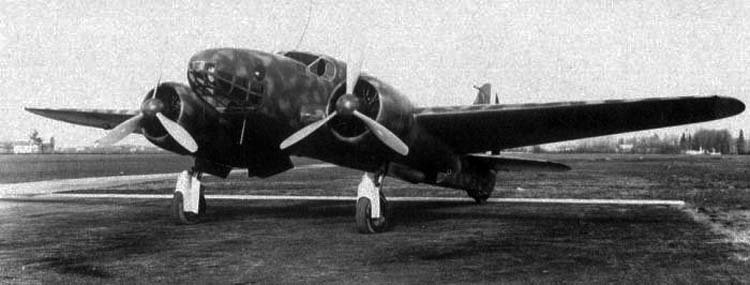
Developed by Cesare Pallavicino, the chief designer at Caproni, the Ca.310 "Libeccio" was conceived in the mid-1930s as a replacement for the Ca.309 Ghibli. While structurally derived from the Ca.309, the Ca.310 introduced significant improvements, most notably the implementation of retractable main landing gear and uprated Piaggio Stella radial engines to enhance speed and payload capacity. The aircraft featured a low-wing monoplane configuration with a metal structure and mixed skinning. To support its multi-role objectives, it was equipped with a glazed nose for observation and bombing, accommodating a three-man crew consisting of a pilot, an observer/bombardier, and a gunner/radio-operator.
Production and Technical Specifications
The prototype first flew on February 20, 1937, and the type was introduced to the Regia Aeronautica in 1938. A total of 312 aircraft were produced, primarily at Caproni's facilities near Milan. While Norway entered a license-production agreement to build ten aircraft at Kjeller, these were never completed due to the German invasion in 1940. The Ca.310 was powered by two air-cooled, 7-cylinder Piaggio Stella P.VII radial piston engines, each producing 470 hp. These engines propelled the aircraft to a maximum speed of approximately 365 km/h, with a cruising speed between 285 and 312 km/h and a service ceiling of 7,000 m. The aircraft had a wingspan of 16.2 m and a maximum take-off weight of roughly 4,650 kg.
Military and Civil Service
The Ca.310 saw its combat debut during the Spanish Civil War, where 16 aircraft were deployed in July 1938 with the Italian Aviazione Legionaria supporting Nationalist forces. During World War II, the Regia Aeronautica utilized the type for reconnaissance and light bombing, particularly in Libya and other low-threat North African theaters. Beyond Italy, the Peruvian Aeronautical Corps employed the Ca.310 in bombing missions against Ecuadorian cities during the Ecuadorian–Peruvian War of July 1941. Other operators included Hungary, Yugoslavia, and the Independent State of Croatia. In Norway, four aircraft were delivered in October 1938; one was notably registered as LN-DAK ("Brevduen") and operated as a civilian mail aircraft flying routes to Copenhagen and Gothenburg.
Operational Assessment and Legacy
Despite its versatility, the Ca.310 was widely regarded as underpowered and obsolete in high-threat environments. Its light defensive armament—consisting of two fixed forward-firing 7.7 mm Breda-SAFAT machine guns and one flexible 7.7 mm gun in a dorsal or ventral turret—and a modest bomb load of 400–450 kg limited its effectiveness. Consequently, it was primarily relegated to secondary theaters or training roles. The last Italian units were retired in 1948. Today, only one known example survives, currently undergoing restoration by the Flyhistorisk Museum Sola in Norway, using parts from various wrecks to preserve the world's last remaining Ca.310.