
Design and Development
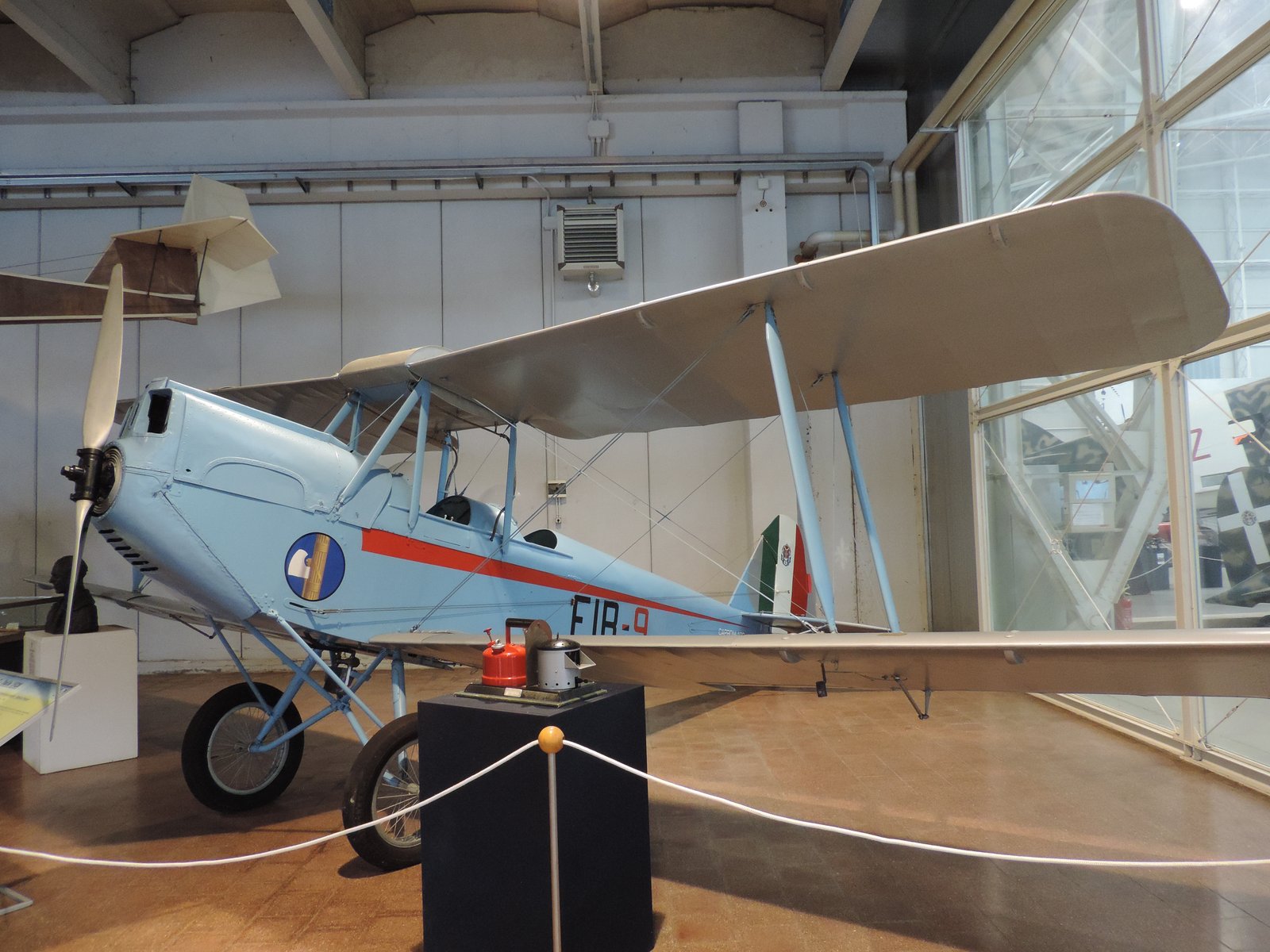
Designed under the leadership of Gianni Caproni, the Ca.100 was developed as a two-seat primary trainer. The design was based on the de Havilland Moth, which Caproni produced under license, though the Ca.100 deviated from the original layout by adopting a reverse sesquiplane configuration, meaning the upper wing was smaller than the lower wing. The wings featured no sweep or stagger, and a streamlined section in the center of the upper wing was utilized to house the fuel tank. Engineered to be docile and forgiving for ab-initio pilot training, the Ca.100 first flew in late 1928.
Production and Manufacturing
Production of the Ca.100 began circa 1929 and continued through at least the later 1930s, although an exact end year for all production is not documented. The aircraft was built in large numbers by Caproni and several Italian license builders, including Breda, Società Aerea Bergamasca (SAB), and C.N.A. The Regia Aeronautica received two prototypes and 675 production units. Additionally, Macchi produced 30 float-equipped versions designated as the Ca.100 Idro.
Beyond Italy, the aircraft saw international license production. In Bulgaria, a Caproni subsidiary produced the aircraft as the KB-1 "Peperuda" during the second half of the 1930s. In Peru, the Fábrica Nacional de Aviones (FNA) produced an all-metal variant designated as the Ca.100PR following a contract in August 1936, with these aircraft entering service from 1937 onward.
Operational History
The Ca.100 served as the primary trainer for the Regia Aeronautica throughout the 1930s. While not used in direct combat, it trained the generation of pilots who served in World War II and the Second Italo–Ethiopian War. A notable performance milestone occurred in 1931, when a Ca.100 Idro set a seaplane altitude record of 17,467 feet (approximately 5,322 m).
In Peru, the aircraft was adopted by the Cuerpo de Aviación del Perú (CAP) as a primary trainer, particularly during the Leticia conflict (1932–1933). The Peruvian military used the type until 1946, after which four aircraft were transferred to the Peruvian Civil Aviation School, where they served as trainers until approximately 1956.
Technical Specifications
The Ca.100 was adaptable to various powerplants. The Bulgarian KB-1 was powered by a 120 hp Walter NZ 120 seven-cylinder radial engine, while the Peruvian Ca.100PR utilized a 125 hp Kinner B-5 five-cylinder radial engine. Italian-built versions used several different engines, generally within the 100–130 hp class.