
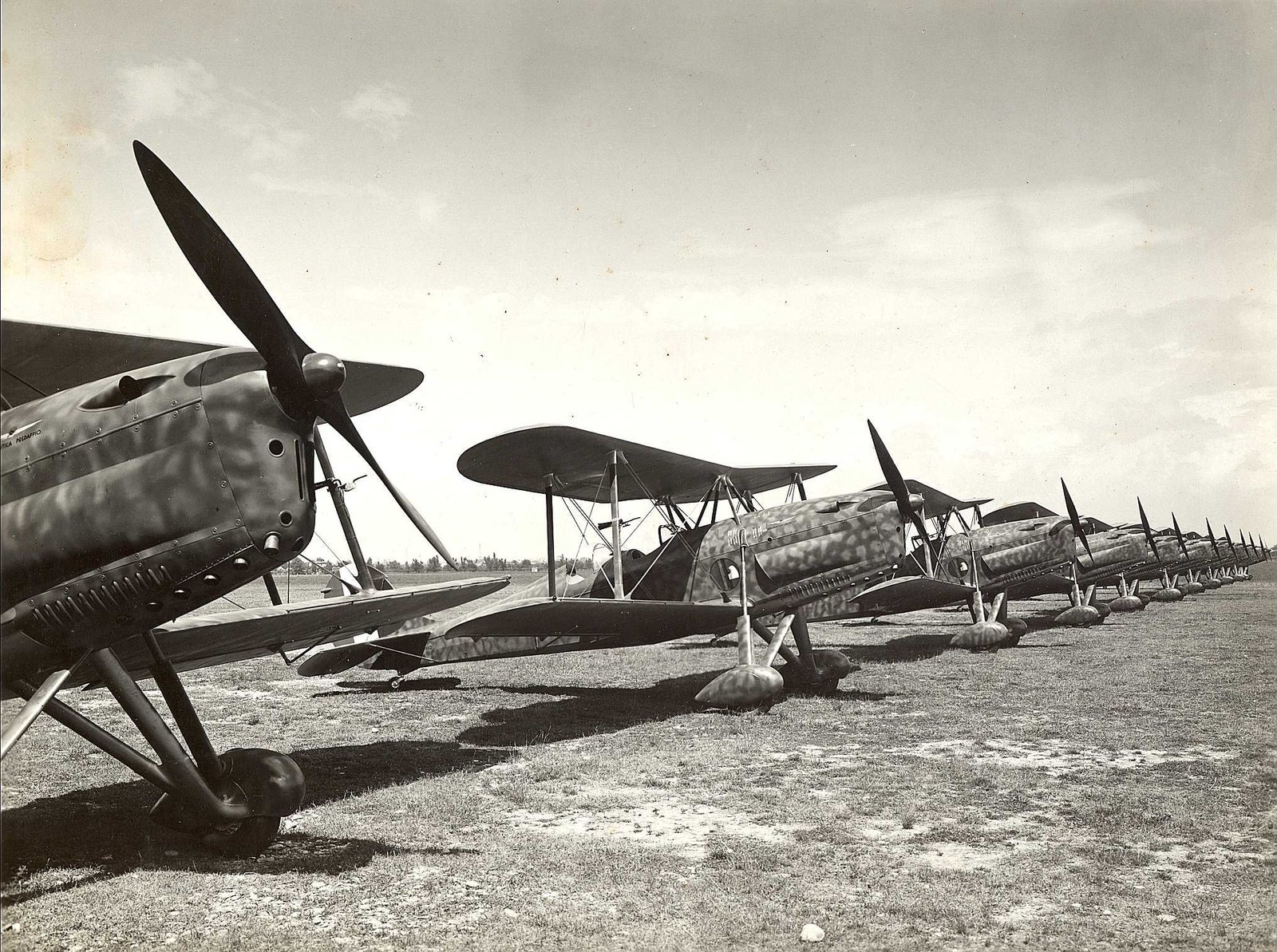
The Caproni Ca.164 was developed in the late 1930s as a successor to the Caproni Ca.100. Designed by Raffaele Conflenti, the aircraft was a two-seat biplane featuring a distinctive inverted sesquiplane wing layout, in which the upper wing was shorter than the lower wing. The airframe construction consisted of a fabric-covered steel tube fuselage and fabric-covered wooden wings.
The prototype, initially designated as the Ca.163, was built by Caproni Taliedo and made its first flight on November 17, 1938, at Forlì airfield. Following competitive tests against the Breda Ba.25, an initial order for 50 aircraft was placed in January 1939. Serial production began in July 1939, with the first production aircraft delivered to a flying school in the autumn of 1939. A total of 281 airframes, including the prototype, were manufactured by Caproni. While production began in 1939 and continued into the early years of the Second World War, the exact end year of production is not documented in accessible references.
Technically, the Ca.164 was powered by a single Alfa Romeo 115 piston engine producing 138 kW (185 hp). This powerplant enabled a maximum speed of 230 km/h and a cruising speed of 184 km/h, with a service ceiling of 4,200 meters and a range of 530 km. Despite its design as a trainer, flight tests revealed poor handling characteristics that rendered the aircraft unsuitable for primary training duties. Consequently, the Regia Aeronautica utilized the type mainly for liaison duties within bomber units, as confirmed by a March 1940 commission chaired by General Francesco Pricolo.
During World War II, the aircraft's role expanded. From June 1941, some were used for training night-fighter pilots or converted into target tugs. Others were equipped with a 7.7 mm machine gun (or in some configurations, two 12.7 mm Breda-SAFAT machine guns) for light support and counter-guerrilla operations in North Africa and on the western and eastern fronts. Additionally, the type was used for tactical reconnaissance during the Croatian campaign. Beyond Italy, France ordered 100 aircraft in January 1940, most of which were transferred to North Africa. Some aircraft were also requisitioned by the German Luftwaffe. No examples of the Ca.164 survive today, although the Ca.163 prototype is preserved at the Gianni Caproni Museum of Aeronautics in Trento, Italy.