
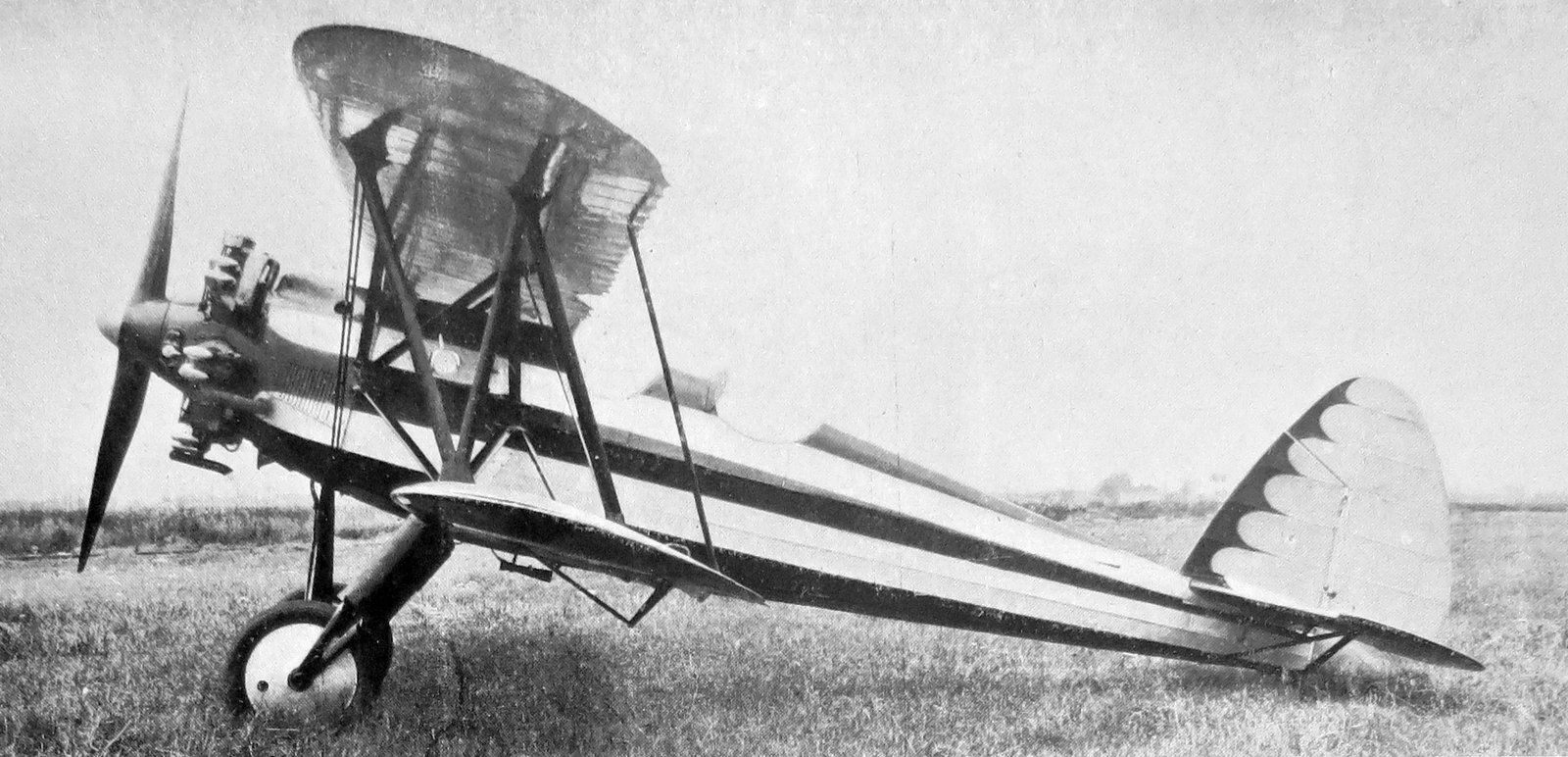
The Caproni Ca.113 was developed in the early 1930s as a more robust and powerful successor to the Ca.100, while drawing design elements from the unsuccessful Ca.109. First flying in 1931, the aircraft was designed as a two-seat advanced trainer and aerobatic machine. Its airframe consisted of a steel tube and wood structure covered in doped fabric and aluminum sheeting. The aircraft featured a single-bay biplane layout with staggered wings of equal span and fixed landing gear equipped with large wheel spats.
Production took place in Italy by Caproni on a small scale to fulfill orders for Portugal and Peru. However, the aircraft saw much larger production in Bulgaria via license production by Bulgar-Caproni at the Kazanlak factory. Between 1938 and 1940, Bulgaria produced 107 aircraft, including the KB-2, KB-2A, and KB-3 trainers, as well as the armed KB-4 Chuchuliga II (reconnaissance/liaison) and KB-5 Chuchuliga III (reconnaissance/light bomber).
The Ca.113 gained international fame through the exploits of Italian pilot Mario De Bernardi, who won an aerobatic trophy at the 1931 Cleveland Air Races and conducted a demonstration tour in China. The airframe's potential was further proven by highly modified variants. On April 11, 1934, Commander Renato Donati of the Regia Aeronautica flew a modified Ca.113 named Alta Quota, powered by a Bristol Pegasus engine, to a world altitude record of 14,433 meters (47,352 ft). In 1935, Contessa Carina Negrone set a women's altitude record of 12,043 meters (39,511 ft) in a Ca.114 (or Ca.113 R) variant equipped with an Alfa Romeo Pegasus S.2 engine.
Standard Italian trainers typically utilized the 370 hp Piaggio Stella P.VII C.35 radial engine, achieving a maximum speed of 250 km/h and a service ceiling between 7,300 and 7,500 meters. Bulgarian variants utilized various powerplants, including the 340 hp Walter Castor II, the 365 hp Wright R-975 E-2 Whirlwind, and the 450 hp Walter Pollux II. The Bulgarian Royal Air Force operated these aircraft in training and combat roles until the Soviet Union overran the country in 1944. Today, at least one airframe is known to survive in a museum collection.