
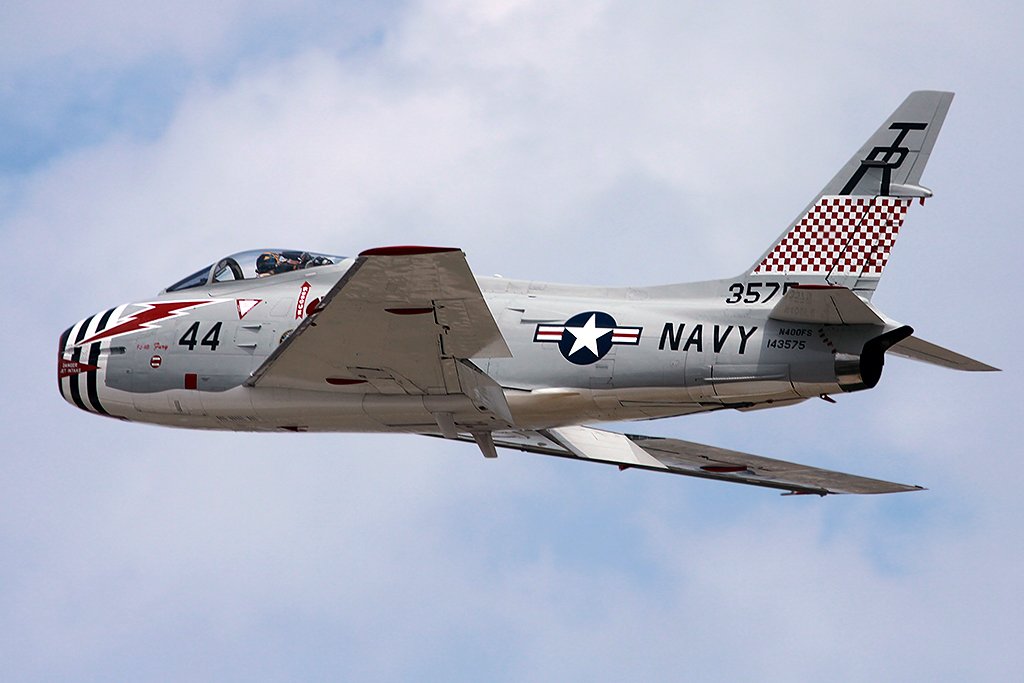
The North American FJ-4 Fury represented the culmination of the Fury family, evolving from the F-86 Sabre line and earlier FJ-2 and FJ-3 variants. Designed by North American Aviation's design team, the FJ-4 was developed as a long-range fighter, featuring a larger fuselage and a thinner, larger laminar-flow wing to increase internal fuel capacity. While it shared ancestry with the F-86, the FJ-4 was a distinct design characterized by a redesigned fuselage spine aft of the cockpit. The prototype first flew on October 28, 1954.
Production of the FJ-4 and its subsequent FJ-4B variant took place between 1954 and 1958, with a total of 374 aircraft built. Manufacturing was conducted by North American Aviation in the United States, specifically at the company's Columbus, Ohio plant. The FJ-4B, the final variant of the series, saw 222 units produced for the U.S. Navy and Marine Corps, with its first flight occurring on December 4, 1956, and entering service in June 1957.
Power was provided by a single Wright J65-W-16A axial-flow turbojet engine, manufactured by Wright Aeronautical, which produced 7,700 lbf of thrust. This powerplant enabled a maximum speed of approximately 680 mph (590 knots), a service ceiling of 46,800 feet, and a rate of climb of 7,660 feet per minute. Depending on the configuration, the aircraft achieved a range between 1,760 nautical miles (with drop tanks) and 2,020 statute miles.
In military service, the FJ-4 was operated by the United States Navy and the United States Marine Corps as a carrier-based fighter-bomber. It was utilized for fighter interception, ground attack, and close air support. The FJ-4B variant was specifically optimized for nuclear strike roles, participating in Low Altitude Bombing System (LABS) delivery training. Its armament included four 20 mm Colt Mk 12 cannons (576 rounds), up to four AIM-9 Sidewinder missiles, and six LAU-3/A 70 mm rocket pods, with a bomb load capacity of up to 3,000 lb. Nine Navy and three Marine Corps squadrons operated the FJ-4B before it was replaced by the Douglas A-4 Skyhawk and McDonnell Douglas F-4 Phantom II. The type was formally retired from U.S. service in December 1964.
Today, the FJ-4's legacy is preserved through a small number of surviving aircraft, with approximately seven known to exist in the United States. Notable examples include FJ-4B BuNo 143575 at the Teton Aviation Center and FJ-4B BuNo 143610.