
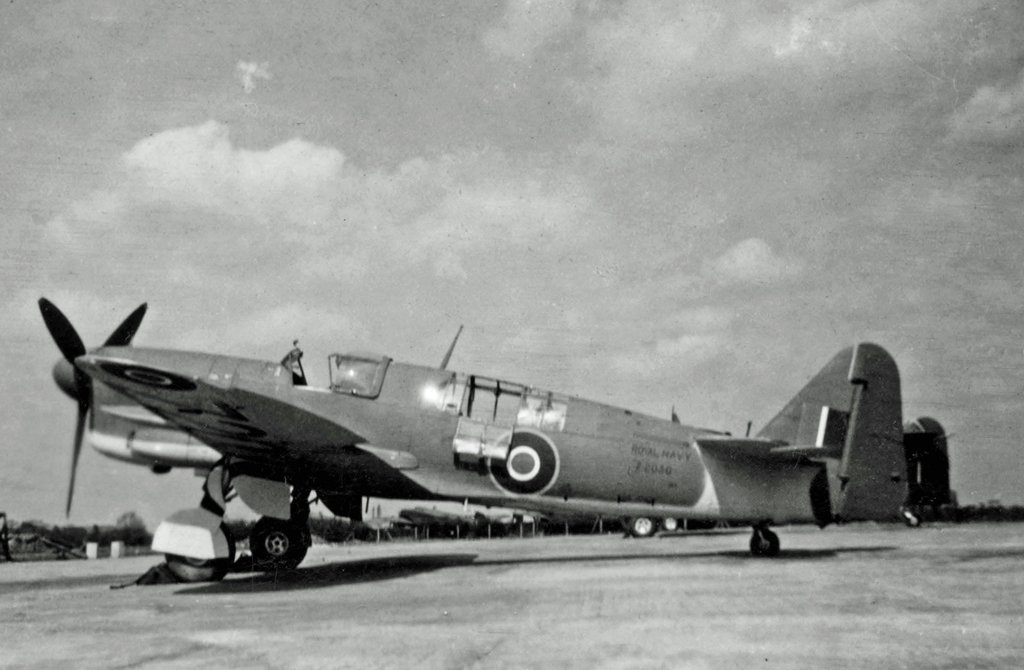
Service History
The Firefly achieved operational status in July 1944 when 1770 Naval Air Squadron embarked aboard HMS Indefatigable, marking the beginning of an intensive combat career that would span multiple theaters. During its wartime service, the aircraft distinguished itself by becoming the first British aircraft to fly over Tokyo during Allied attacks on the Japanese capital. The type served extensively in fighter, reconnaissance, strike, anti-submarine, and bombing roles, demonstrating the versatility that made it invaluable to Fleet Air Arm operations.
By war's end, the Firefly had proven itself across all operational theaters, with Fleet Air Arm pilots consistently praising its performance capabilities. The aircraft's multi-role design allowed it to adapt quickly to changing tactical requirements, whether conducting fleet defense missions or ground attack operations against enemy installations.
Combat Variants and Armament
The primary wartime variant, designated F Mk I, entered production in January 1943 with 459 aircraft of this type manufactured. Each Firefly carried formidable armament consisting of four 20mm Hispano cannon mounted two per wing, providing devastating firepower against both aerial and surface targets. By April 1944, the aircraft received clearance for underwing ordnance, expanding its capabilities to include up to eight 60-pound rockets or two 1,000-pound bombs.
This weapons flexibility transformed the Firefly from a pure fighter into a potent strike platform capable of engaging diverse target sets. The combination of cannon armament and external stores made it particularly effective in the Pacific theater, where it operated against both Japanese aircraft and ground installations.
The Manufacturer
Fairey Aviation Company, founded in 1915 by Charles Richard Fairey, developed the Firefly as part of its distinguished line of naval aircraft that included the legendary Swordfish and Fulmar. The company operated independently throughout the interwar period and World War II, establishing itself as a premier supplier to the Royal Navy's Fleet Air Arm. During the Battle of Britain, Fairey faced development delays as resources were diverted to more immediate defense needs, but the company maintained its focus on naval aviation requirements.
Manufacturing occurred primarily at Fairey Aviation facilities, with General Aircraft joining production efforts from late 1943 to meet delivery schedules. The collaboration resulted in total production of 872 aircraft across all variants. Fairey Aviation Company ceased independent operations in 1960 when Westland Aircraft acquired the firm, with Westland later merging into what eventually became Leonardo Helicopters.
Engine and Technical Innovation
The Firefly's performance relied on the Rolls-Royce Griffon IIB inline V-12 engine, producing 1,735 horsepower and enabling the aircraft to achieve superior speed and handling compared to its predecessors. This powerplant, manufactured by Rolls-Royce during the 1940s with over 4,200 units built across all variants, proved exceptionally reliable for carrier operations. Later variants featured the more powerful Griffon 72 engine, generating 2,330 horsepower when first flown in 1944.
Design innovations included Fairey-Youngman flaps and completely new components rather than derivatives of the earlier Fulmar. The engineering team addressed early handling issues through modifications including extended elevators and metal-skinned ailerons, eliminating problematic porpoising characteristics that had affected initial flight testing.
Development and Testing
The Firefly originated from British Admiralty Specification N.8/39, issued in March 1939, calling for a two-seat multi-role naval fighter to replace the Sea Gladiator, Skua, and Fulmar. The mock-up received approval on June 6, 1940, followed by an initial order for 200 aircraft on June 12, 1940. Despite achieving a 40 mph speed improvement over the Fulmar while adding 4,000 pounds of weight, the program faced a tragic setback when the second prototype crashed on June 26, 1942, killing chief test pilot Christopher Staniland.
Admiralty pilots Mike Lithgow and Roy Sydney Baker-Falkner conducted official testing at Boscombe Down in 1942, evaluating the aircraft's carrier suitability and combat effectiveness. Their assessments confirmed the Firefly's readiness for operational service, leading to squadron deliveries beginning October 1, 1943.
Legacy and Impact
The Firefly represented a crucial bridge between pre-war naval aviation and the jet age, serving as the Fleet Air Arm's most capable multi-role carrier aircraft during the critical final phase of World War II. Its successful integration of fighter and strike capabilities established design principles that influenced subsequent naval aircraft development. The type continued in postwar service through various roles including target towing, demonstrating the soundness of its original design concept.
Today, the Firefly holds significance in aviation history as an example of successful wartime aircraft development under extreme pressure, combining innovative engineering with practical operational requirements to create an effective naval weapon system.