
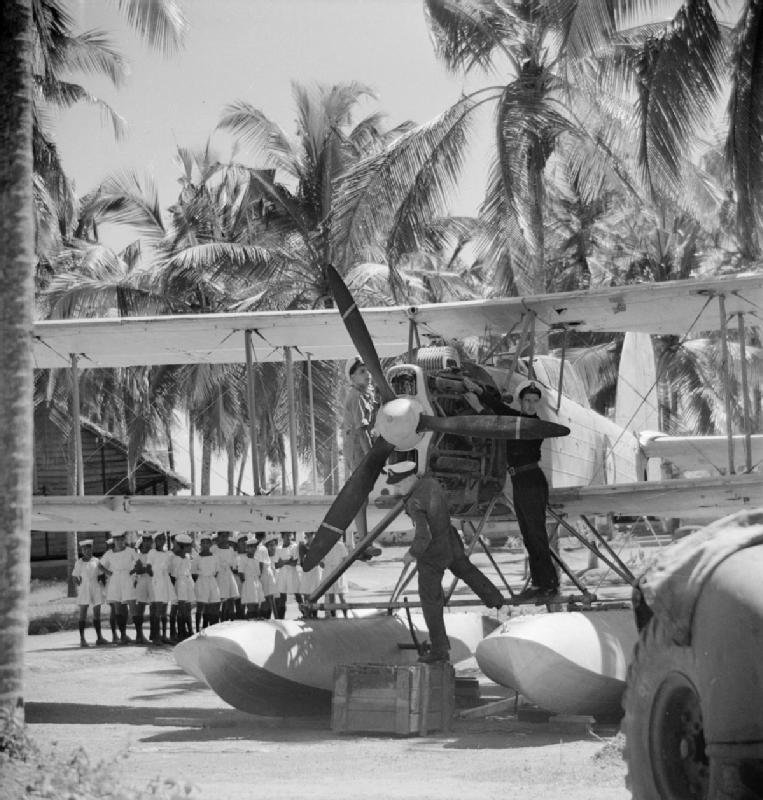
The Fairey Seafox was developed as a response to Air Ministry Specification S.11/32, issued in 1932, which called for a ship-borne reconnaissance floatplane suitable for the Royal Navy's light cruisers and the Fleet Air Arm. Designed and built by the Fairey Aviation Company, the aircraft first flew on May 27, 1936. It entered active service in April 1937, featuring a single-engine biplane configuration with twin floats for water operations. The crew consisted of a pilot and an observer/gunner seated in tandem open cockpits, with a design emphasis placed on visibility and low-speed handling rather than high-speed performance.
Production was limited, totaling 66 aircraft, which included two prototypes and 64 production units. While the exact factory locations are not specified, Fairey operated principal production sites at Hayes, Middlesex, and Heaton Chapel/Ringway in Cheshire. The Seafox was powered by a Napier Rapier VI, a 16-cylinder air-cooled piston engine produced by D. Napier & Son Ltd, delivering approximately 395 horsepower. In terms of armament, the aircraft was typically lightly armed, often carrying an optional 0.303 in (7.7 mm) Lewis machine gun for the rear observer and under-wing racks capable of holding four 20 lb bombs or marking flares.
During the early stages of the Second World War, the Seafox served as the 'eyes-in-the-skies' for the fleet. At the outbreak of war in September 1939, 32 aircraft were in service, and they were immediately deployed against German naval targets. The type is most notable for its role in the hunt for the German pocket battleship Admiral Graf Spee in the South Atlantic, providing the reconnaissance and spotting that contributed to the vessel's eventual scuttling off Montevideo, Uruguay, in December 1939. Additionally, Seafoxes supported operations during the evacuation of Crete in 1941. The aircraft served in approximately eleven Fleet Air Arm squadrons, with some units also operating with Australian and New Zealand naval forces. By 1943, the Seafox was phased out of front-line service in favor of more modern aircraft. With a maximum speed of 125 mph and a range of 440 miles, the Seafox represented the final generation of small, ship-launched biplane floatplanes used by the Royal Navy.