
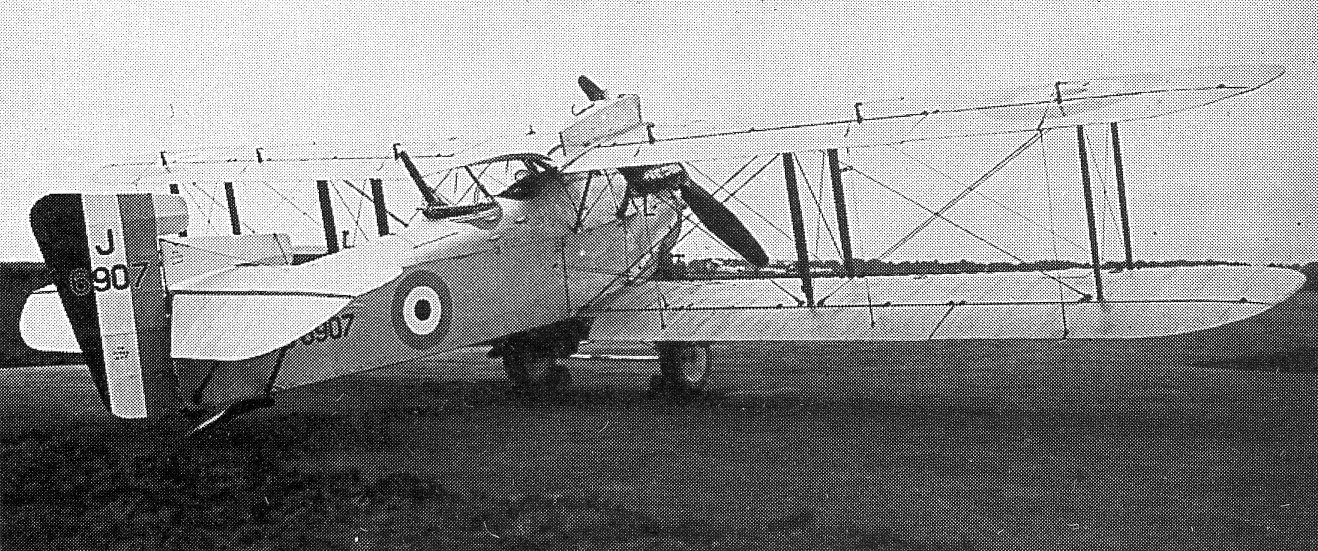
Designed by F. Duncanson for the Fairey Aviation Company, the Fairey Fawn was developed under Specification 5/21 to serve as a replacement for the Airco DH.9A. The aircraft was intended for a variety of roles, including light day-bombing, reconnaissance, and army cooperation. It featured a two-seat, single-engine biplane configuration powered by a liquid-cooled V-12 engine.
Production of the Fawn took place in the early-to-mid 1920s, resulting in a total of 75 aircraft. This production run was divided into three distinct groups: five prototype and pre-production machines, 50 Fawn Mk II aircraft, and 20 Fawn Mk III aircraft. The primary technical difference between the production variants was the engine; the Mk II utilized the Napier Lion II, while the Mk III was equipped with the Napier Lion V. The Lion engine was a distinctive 12-cylinder, water-cooled "broad-arrow" piston engine, with the Mk III variant rated at 468 hp (349 kW).
In terms of performance, the Fawn Mk III reached a maximum sea-level speed of 114 mph (183 km/h) and possessed a range of 650 miles (1,050 km). It had a service ceiling of 13,850 feet and could climb to 5,000 feet in 6 minutes and 30 seconds. The aircraft's physical dimensions included a wingspan of 49 feet 11 inches and a length of 32 feet 1 inch. With an empty weight of 3,481 lb, it could reach a gross weight of 5,834 lb. For armament, the Fawn carried one fixed forward-firing .303 in Vickers machine gun and one or two .303 in Lewis guns mounted on a Scarff ring in the rear, while underwing racks could carry up to 460 lb of bombs.
The Royal Air Force operated the Fawn from 1924 to 1929. It first entered service with No. 12 Squadron in March 1924, followed by No. 11 Squadron and No. 100 Squadron in May 1924. By 1926, the type was replaced in these regular squadrons by the Fairey Fox and Hawker Horsley. However, the Fawn continued to serve in auxiliary and reserve capacities, including No. 503 Squadron RAF Special Reserve (from October 1926 to June 1929) and No. 602 Squadron RAF Auxiliary Air Force (from September 1927 to October 1929). The Fawn represents a transitional phase in British military aviation before the arrival of faster biplane bombers and monoplanes.