
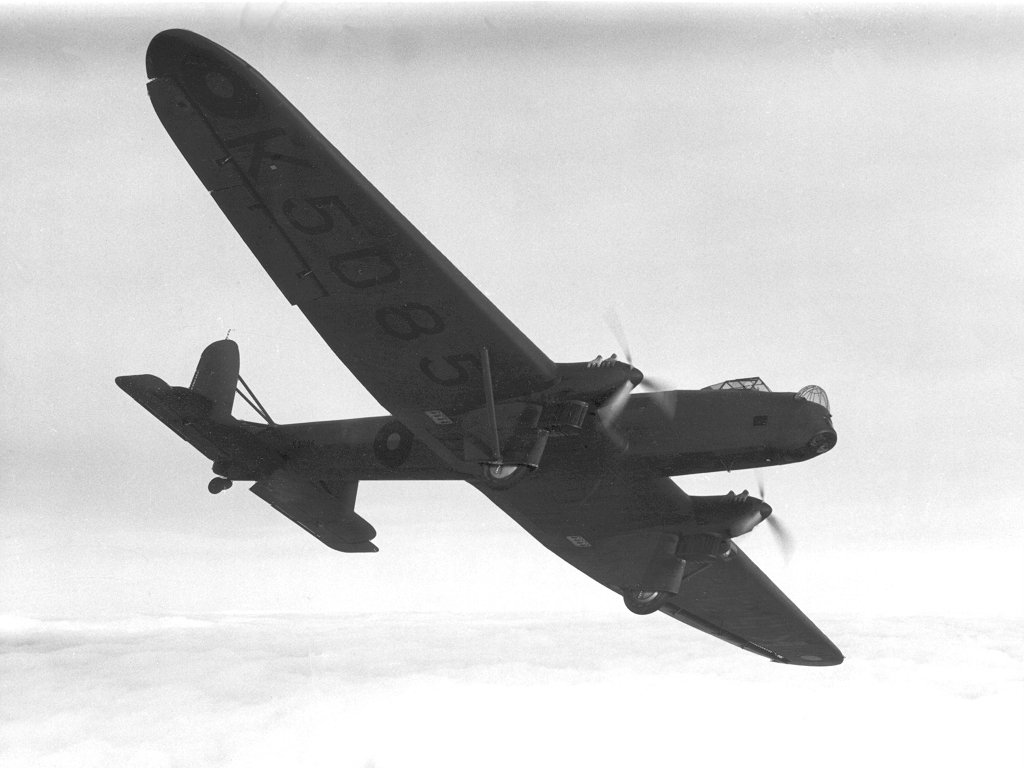
Design and Development
The Fairey Hendon was developed by the Fairey Aviation Company to meet Air Ministry Specification B.19/27, which sought a heavy night bomber to replace the Vickers Virginia. The specification required an aircraft capable of carrying a 1,500 lb bomb load over a range of approximately 920 miles at speeds of at least 115 mph. The resulting design was a significant departure from contemporary RAF bombers, featuring an all-metal construction, a cantilever low wing, and retractable landing gear. It also incorporated an enclosed cockpit and an internal bomb bay. The prototype, initially designated as the Fairey Night Bomber (K1695), made its first flight on November 25, 1930.
Despite its innovations, development was hindered by heavy control forces and a lack of flaps, which led to a landing accident that severely damaged the prototype. These issues delayed the aircraft's entry into service for several years. The production version, the Hendon Mk.II, was powered by two liquid-cooled, upright V-12 Rolls-Royce Kestrel VI piston engines, each producing 600 hp.
Production and Manufacturer
Fairey Aviation Company, founded in 1915 by Charles Richard Fairey and Ernest Oscar Tips, produced a total of 15 aircraft, including the prototype. While the prototype was built at Fairey's main works, the 14 production Mk.II airframes were manufactured at the Heaton Chapel factory in Stockport, Cheshire. By the early 1960s, Fairey's aircraft interests were absorbed into the British Aircraft Corporation (BAC), and the company no longer exists as an independent aircraft manufacturer.
Service History
The Hendon entered Royal Air Force squadron service in November 1936 with No. 38 Squadron, operating from RAF Mildenhall and later RAF Marham. It was later utilized by No. 115 Squadron. Designed as a heavy night bomber, the aircraft's front-line career was brief, lasting from 1936 to 1938. By late 1938, the Hendon was considered obsolete and was replaced by the more advanced Vickers Wellington. No. 38 Squadron began receiving Wellingtons in November 1938, and the last recorded flight of a Hendon occurred in early January 1939. Following their withdrawal from combat roles, some airframes were used for ground instruction at a radio school at RAF Cranwell.
Technical Specifications and Legacy
The Hendon Mk.II had a wingspan of 101 ft 9 in and a length of 60 ft 9 in, with a maximum take-off weight of 20,000 lb. It reached a maximum speed of 152 mph at 15,000 ft and had a service ceiling of 21,400 ft. For defense, it carried three .303 in Lewis guns located in the nose, dorsal, and tail positions. Its internal bomb bay could carry an operational load of 1,660 lb, though design provisions allowed for up to 2,548 lb.
No Fairey Hendons survive today; all were scrapped after their retirement. Despite its obscurity and small production run, the Hendon is historically significant as the transitional link that introduced the all-metal monoplane configuration to the RAF's bomber fleet.