
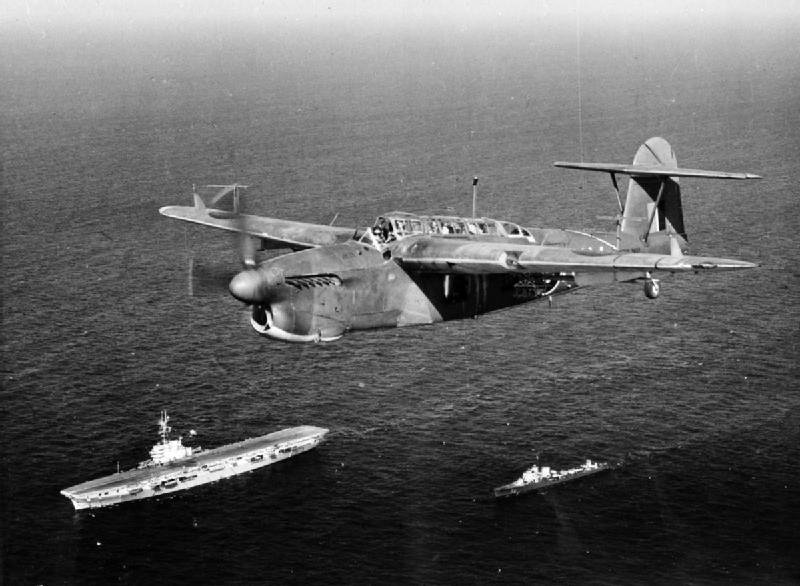
The Fairey Barracuda was developed by the Fairey Aviation Company to meet Air Ministry Specification S.24/37. It represented a significant technological leap for the Royal Navy's Fleet Air Arm, serving as the first all-metal monoplane torpedo bomber to enter service, effectively replacing the biplane designs of the Swordfish and Albacore. The prototype, designated Type 100, first flew on December 7, 1940. While the design was credited to Fairey's internal engineering staff rather than a single individual, the aircraft incorporated several advanced features, most notably the Fairey-Youngman flaps. These specialized surfaces acted as both dive brakes and high-lift devices, enabling the aircraft to perform stable dive-bombing maneuvers and improving low-speed handling.
Production began in earnest with the Barracuda Mk I, which first flew in May 1942, though it was produced in limited numbers (approximately 30 aircraft) due to being under-powered. The aircraft entered squadron service in January 1943 with 827 Naval Air Squadron. To meet wartime demands, the British government utilized a shadow factory system; while Fairey led production at Heaton Chapel and Ringway, Blackburn Aircraft (Brough) and Westland Aircraft (Yeovil) served as major subcontractors, alongside Boulton Paul and Scottish Aviation. A total of 2,607 aircraft were constructed between 1942 and 1945, with the Mk II becoming the primary wartime variant.
Technically, the Barracuda was powered by liquid-cooled Rolls-Royce V-12 piston engines. The Mk I used the Merlin 30 (1,300 hp), while the Mk II and Mk III utilized the Merlin 32, which provided approximately 1,640 hp. A late-development Mk V variant featured the Rolls-Royce Griffon 37 engine producing 2,020 hp, though it did not reach mass production. The aircraft carried a crew of three—a pilot, observer/navigator, and radio operator/air gunner—housed under a large greenhouse canopy. For armament, it typically featured two 0.303 in Browning machine guns in the wings and one 0.303 in Vickers K flexible gun in the rear. Its offensive payload included either one 18-inch torpedo or up to 1,620 lb of bombs or depth charges.
During World War II, the Barracuda operated extensively across the European, Mediterranean, and Pacific theatres. It is most remembered for its role in Operation Tungsten and other 1944 raids against the German battleship Tirpitz in Norway. The Mk III variant, equipped with ASV radar, was vital for anti-submarine warfare and convoy protection in the North Atlantic and Arctic. Despite its utility, the aircraft was often criticized by pilots for demanding handling and insufficient power. Following the war, the aircraft was quickly retired. No complete Barracuda survives today, although the Fleet Air Arm Museum holds substantial wreckage and components for potential reconstruction.