
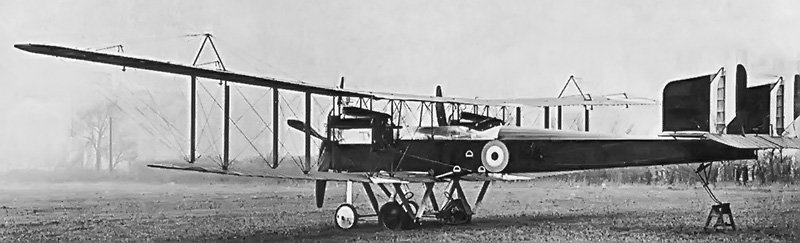
The Fairey F.2 was a British fighter prototype developed during World War I to meet a 1916 Admiralty requirement for a large, long-range, three-seat fighter. The aircraft holds a distinct place in aviation history as the first aircraft designed entirely by the Fairey Aviation Company, marking the firm's transition from a builder of other designs to an original manufacturer. The company was founded by Charles Richard Fairey and became closely associated with the development of military and naval aircraft during the interwar and postwar eras.
Constructed as a single prototype, the F.2 featured a three-bay biplane configuration. Its design included several notable technical features, such as folding wings and a four-wheel "bedstead" undercarriage. The aircraft was manufactured at Harlington, after which it was transported by road to Northolt Aerodrome for its initial flight trials. The F.2 first took to the air on 17 May 1917.
Power was provided by two water-cooled Rolls-Royce Falcon piston engines, each capable of producing 190 hp (142 kW). In terms of performance, the prototype reached a maximum speed of 93 mph (150 km/h or 81 kn) and possessed an endurance of 3 hours and 30 minutes. For combat, the aircraft was equipped with two .303 in (7.7 mm) Lewis guns.
Despite the innovative intent behind its design, the F.2 failed to enter production. Operated by the Royal Naval Air Service, the aircraft was judged to be slow and difficult to handle. By the time the prototype completed its flight tests in 1917, interest from the Admiralty had waned. Consequently, no further aircraft were built, and the F.2 remained a one-off prototype. There are no known surviving airworthy examples or museum pieces of the aircraft today. Its primary legacy remains its role as the foundational design that established Fairey Aviation's capabilities as an independent aircraft designer.