
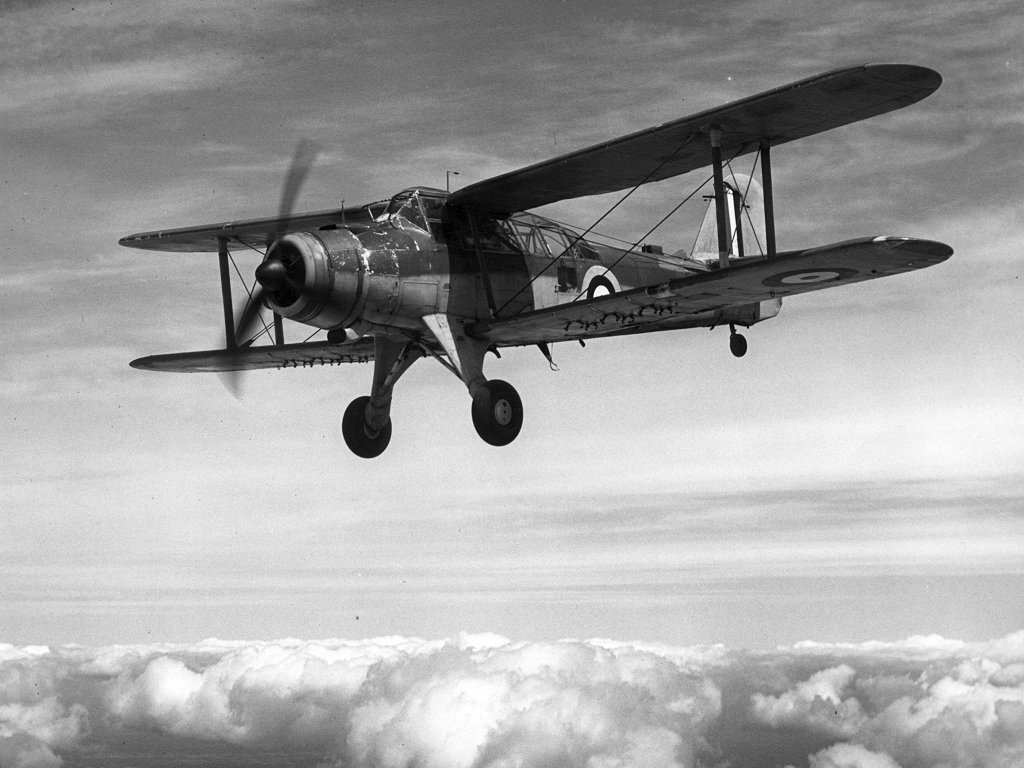
Designed by Marcelle Lobelle at Fairey Aviation, the Albacore was developed to modernize the Royal Navy's strike capabilities by replacing the aging Fairey Swordfish. The aircraft first took flight on 12 December 1938, with the prototype L7074 departing from Fairey’s Great West Aerodrome. To improve upon its predecessor, Lobelle incorporated an enclosed cockpit to enhance crew comfort and a more powerful engine to increase performance. The resulting aircraft was a three-seat biplane capable of performing a wide array of missions, including torpedo attacks, dive bombing, level bombing, reconnaissance, and spotting.
Production took place between 1939 and 1943, primarily at Fairey’s Hayes factory. A total of 800 aircraft were built, a figure that includes the two initial prototypes. The Albacore was powered by a Bristol Taurus XII piston radial engine, which delivered 1,130 hp. This powerplant enabled a top speed of 161 mph and a service ceiling of 20,700 ft, while providing a maximum range of 930 miles.
The Albacore entered combat on 31 March 1940, when No. 826 Squadron conducted attacks against E-boats off the coast of Belgium. Throughout World War II, the type saw extensive service across multiple theaters, including the English Channel, the Atlantic, the Arctic, the Indian Ocean, and the Mediterranean. In March 1941, Albacores were involved in operations targeting the Italian warship Vittorio Veneto. During the Normandy landings in June 1944, No. 415 Squadron of the RCAF utilized the aircraft for anti-shipping patrols off the French coast. At its peak, the Albacore was operated by 36 different squadrons, including 15 within the Fleet Air Arm, as well as units from the RAF and RCAF.
Despite its technical advancements, the Albacore did not achieve the long-term status as a replacement for the Swordfish that the Air Ministry and Fairey had envisioned. Front-line service with the RAF concluded on 23 January 1945 with No. 119 Squadron, though the Royal Canadian Navy continued to operate the aircraft until 1949. Today, the Albacore's legacy is that of a hardworking but overshadowed torpedo bomber, with only one airframe known to have survived.