
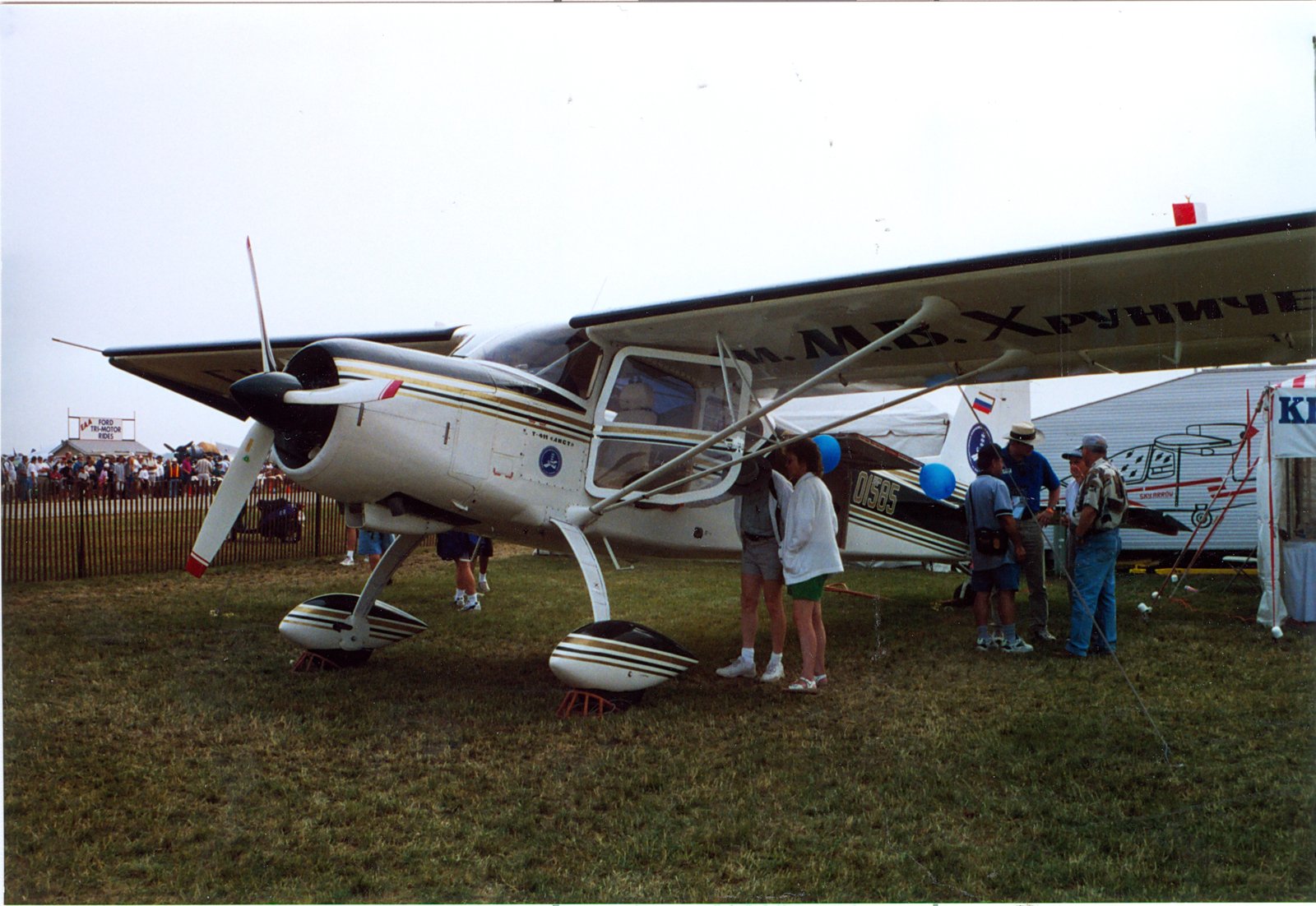
Development Origins
The T-411 Aist emerged from Russia's post-Soviet efforts to modernize its military aviation capabilities for asymmetric warfare. Design work commenced in November 1992 under ROKS-Aero corporation, a Moscow-based company established in 1990 specifically to develop general aviation aircraft for the new Russian market. When ROKS-Aero transformed into Aeroprogress in 1993, the project gained momentum as a potential solution for light attack and reconnaissance missions.
Construction of the prototype began in April 1993, with the aircraft achieving its maiden flight on November 10, 1993. The rapid development timeline reflected both the urgency of Russia's military modernization needs and the relatively straightforward nature of the design, which prioritized ruggedness and operational simplicity over advanced technology.
Design Philosophy and Configuration
The Aist embodied traditional Russian design principles emphasizing durability and maintenance simplicity. Its high-wing braced monoplane configuration provided excellent ground clearance and stability during low-speed operations essential for reconnaissance and forward air control missions. The tubular steel fuselage construction offered exceptional strength-to-weight ratios while remaining economical to manufacture.
Engineers selected the NACA 23011 airfoil for the metal fabric-covered wings, spanning 42 feet 9 inches with an aspect ratio of 7.0:1. This configuration delivered a stall speed of just 58 mph with flaps deployed, enabling operations from unprepared airstrips as short as a few hundred meters. The aircraft's versatility extended to its landing gear options, accommodating wheels, skis, or floats for diverse operational environments.
Powerplant and Performance
The heart of the T-411 was its Vedeneyev M14P nine-cylinder air-cooled radial engine, producing 360 horsepower and driving a three-bladed propeller. This powerplant choice reflected Russian preferences for proven, reliable designs over cutting-edge technology. The M14P's radial configuration provided excellent cooling characteristics and simplified maintenance procedures crucial for operations in remote locations.
With a maximum takeoff weight of 3,638 pounds and an empty weight of just 1,199 pounds, the Aist achieved respectable performance figures. Its cruise speed of 127 mph and range of 750 miles provided adequate capabilities for reconnaissance and light attack missions, while the service ceiling of 9,800 feet suited low-altitude tactical operations.
Manufacturing Partnership
Production responsibilities fell to the Khrunichev State Research and Production Space Center, which established an aviation department in 1994 and purchased licensing rights from Aeroprogress. This partnership represented an unusual collaboration between Russia's space industry and aviation sector. Khrunichev, organized in 1993 from the historic M.V. Khrunichev Machine-Building Factory, brought substantial manufacturing capabilities to the project.
The Khrunichev facility's aviation heritage stretched back to April 30, 1916, when the Russian-Baltic joint-stock company established the plant for automobile production. During the Soviet era, the facility produced notable aircraft including the TB-1 and TB-3 bombers, the Tu-4 strategic bomber, and the M-4 jet bomber series. Actual airframe production was subcontracted to Production Complex #2 of RAC MIG in Voronin, leveraging existing aircraft manufacturing expertise.
Military Applications and Export Efforts
The T-411 was specifically conceived as a counter-insurgency aircraft capable of reconnaissance, forward air control, and light attack missions. Russian military planners envisioned the type operating in conflicts similar to those where American OV-10 Broncos and A-1 Skyraiders had proven effective. The aircraft's ability to operate from short, unprepared strips made it particularly attractive for operations in challenging terrain.
Marketing efforts extended to international customers, with the aircraft promoted as an economical alternative to Western light attack aircraft. The two-seat configuration allowed for pilot-observer teams essential for reconnaissance missions, while the substantial payload capacity of 795 pounds enabled various mission equipment configurations.
Commercial Variants and Limited Success
Recognizing potential civilian markets, Aeroprogress developed a variant marketed in the United States as the T-411 Wolverine, powered by a Continental TSIO-550-B engine rather than the Russian radial. Additionally, a homebuilt derivative appeared as the Washington T-411 Wolverine, offered in kit form to amateur builders.
Despite these marketing efforts, the T-411 program achieved only limited commercial success. Production numbers remained low, with no publicly documented figures suggesting significant sales to either military or civilian operators. The aircraft's failure to achieve market penetration likely stemmed from competition with established Western designs and Russia's economic challenges during the 1990s.
Legacy and Current Status
The T-411 Aist represents a fascinating footnote in post-Cold War Russian aviation development. While the program failed to achieve commercial success, it demonstrated Russia's continued capability to develop practical, rugged aircraft designs suited to specific operational requirements. The aircraft embodied traditional Russian engineering values of simplicity, durability, and operational flexibility.
Today, few T-411s remain in service, and production has effectively ceased. The type's limited impact stands in contrast to more successful Russian aircraft programs, highlighting the challenges facing specialized military aircraft in the post-Cold War era. Nevertheless, the Aist remains notable as one of the few Russian light attack aircraft to achieve actual production status during the 1990s modernization period.