
Service History
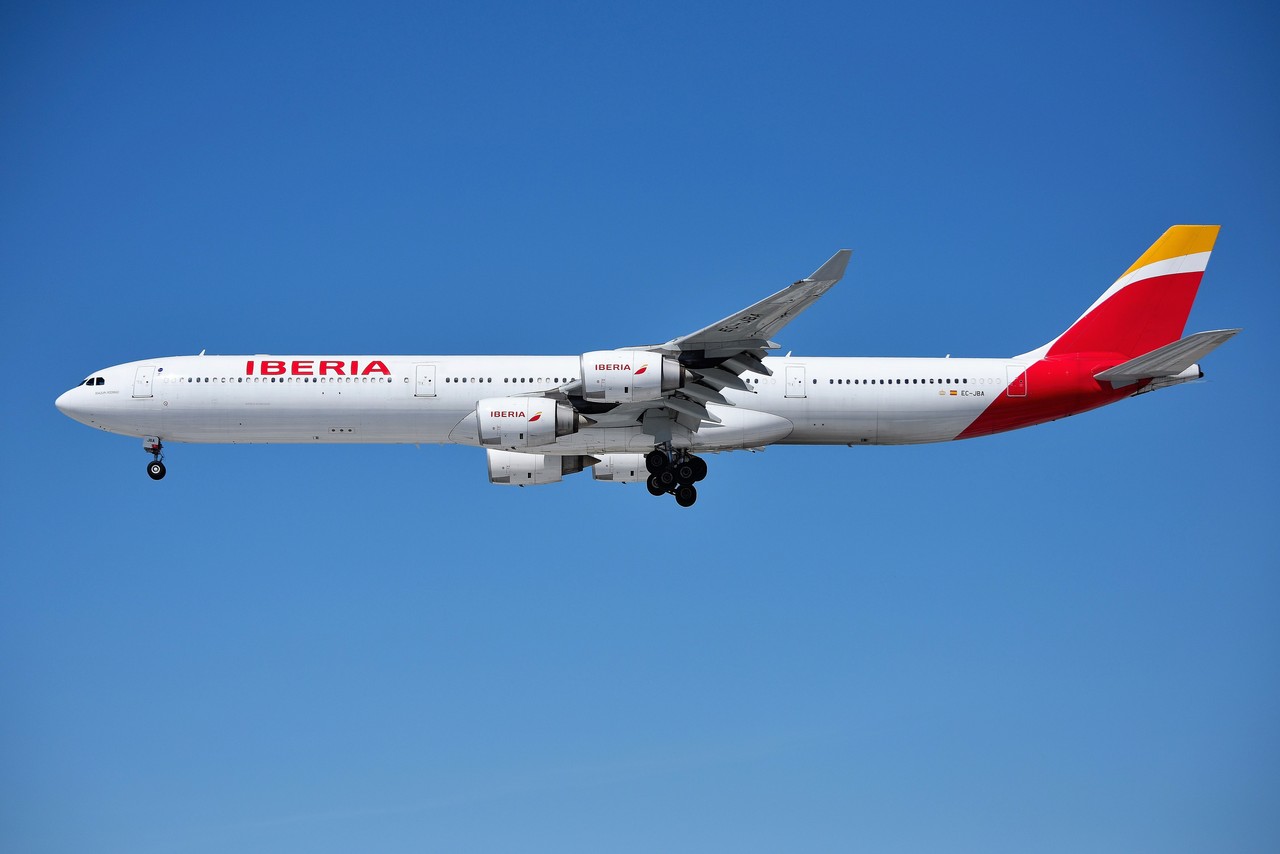
Virgint Atlantic launched A340-600 operations in August 2002, immediately deploying the aircraft on demanding transatlantic routes where its four-engine configuration eliminated Extended-range Twin-engine Operational Performance Standards (ETOPS) restrictions. Major European carriers quickly followed, with Lufthansa operating 62 total A340s across variants by 2019, including 32 still active. Iberia incorporated 17 A340-600s into their long-haul fleet, while the type enabled airlines to operate ultra-long routes up to 9,000 nautical miles without the regulatory constraints imposed on twin-engine aircraft over water.
The A340-600's capacity advantage proved substantial in high-density markets, accommodating 440 passengers in maximum configuration or 375 in standard layouts. This passenger capability, combined with its 14,630-kilometer range in the High Gross Weight variant, allowed airlines to serve previously challenging city pairs with a single aircraft type.
The Manufacturer
Airbus originated from a 1970 European consortium comprising Aerospatiale, Deutsche Airbus, Hawker Siddeley, and CASA, representing a coordinated challenge to American aviation dominance. The consortium evolved through multiple reorganizations, merging with EADS in 2000 before becoming Airbus SE in 2017. Manufacturing centered in Toulouse, France, where the company maintains its headquarters and primary assembly facilities.
The A340 program represented Airbus's strategic response to Boeing's 777, offering airlines a four-engine alternative for routes where twin-engine reliability remained questionable. Airbus continues operations today as a major aircraft manufacturer, having expanded beyond the original European partners into a global aerospace corporation.
Engine & Technical Details
Four Rolls-Royce Trent 556 high-bypass turbofan engines powered the A340-600, each delivering 226 kilonewtons (51,000 pounds) of thrust. Rolls-Royce developed the Trent 556 specifically for the A340-500/600 variants, building upon their successful Trent family that began production in the 1990s. The engine selection prioritized power and reliability over fuel efficiency, reflecting the era's emphasis on capability rather than operating economics.
The aircraft required a standard two-pilot crew and incorporated several innovative design features. Engineers added a distinctive plastron underwing bulge to enhance wing stiffness and prevent flutter at cruise altitude. The -600 variant stretched 15.96 meters longer than the original A340-200, necessitating structural reinforcements throughout the fuselage. Later High Gross Weight models introduced laser beam welding techniques, certified on April 14, 2006.
Pilot Perspective
Pilots appreciated the A340-600's stability and redundancy on extended overwater flights, where four engines provided psychological comfort and regulatory compliance advantages. The aircraft's maximum service ceiling of 43,000 feet and cruise speed of Mach 0.86 delivered competitive performance on long-haul routes. However, the four-engine configuration demanded higher fuel consumption compared to contemporary twin-engine alternatives, creating operational cost pressures that ultimately limited the type's commercial appeal.
Cockpit systems reflected Airbus's fly-by-wire philosophy, maintaining commonality with other A340 variants and the A330 family. This design approach reduced pilot training costs for airlines operating multiple Airbus types while ensuring consistent handling characteristics across the fleet.
Production & Legacy
Airbus produced the A340-600 from 2001 to 2011, manufacturing 131 examples of the -500/-600 variants combined within the overall A340 family total of 375 deliveries. Production concentrated in Toulouse, where final assembly occurred alongside other Airbus programs. The program concluded as airlines increasingly favored fuel-efficient twin-engine aircraft like the Boeing 777 and Airbus's own A350.
The A340-600's legacy remains complex: while successful in demonstrating European long-range capability, it arrived as aviation economics shifted toward twin-engine efficiency. Several dozen examples continue flying with operators including Lufthansa and Iberia as of 2025, though the youngest aircraft are approximately 14 years old. The type symbolizes the end of the four-engine era for commercial aviation, representing sophisticated engineering ultimately overtaken by operational economics and regulatory evolution that reduced ETOPS restrictions for modern twin-engine aircraft.