
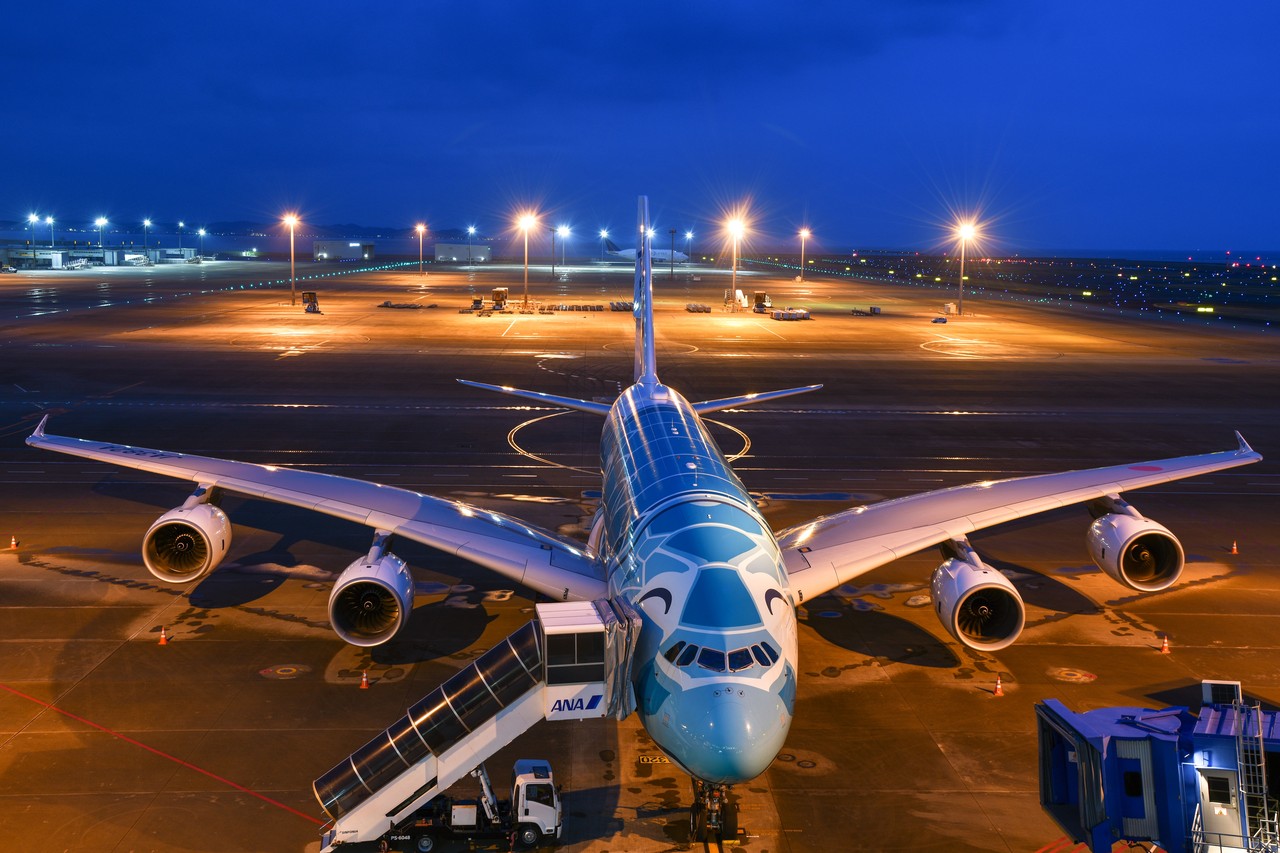
Commercial Dominance and Market Impact
The A380-800 entered commercial service on October 25, 2007, with Singapore Airlines operating the inaugural passenger flight, marking the beginning of a new era in high-capacity air travel. Emirates emerged as the aircraft's dominant operator, ultimately taking delivery of 123 units—nearly half of all A380s produced. The airline's strategic use of Dubai as a global hub perfectly matched the A380's design philosophy of connecting major metropolitan areas with maximum passenger capacity.
At its peak, eight airlines operated the superjumbo: Emirates, Singapore Airlines, Lufthansa, Air France, Qantas, Korean Air, Malaysian Airlines, and British Airways. The aircraft's passenger appeal was immediate and sustained, with travelers specifically choosing flights operated by A380s for their spacious cabins, reduced noise levels, and premium amenities that the large fuselage enabled.
Development Challenges and Engineering Triumph
Airbus launched the A380 program formally in 2000 after five years of preliminary research and design work, investing €8.8 billion initially in what would become aviation's most ambitious commercial project. The aircraft's complexity became evident during assembly, requiring installation of over 350 miles of wiring per aircraft—a task that created significant manufacturing bottlenecks.
Production delays plagued the program from its earliest stages. What began as a six-month delay announced in June 2005 escalated to 12-13 months by October 2006, ultimately adding €5 billion to development costs and bringing total program investment to €18 billion. Despite these setbacks, the A380 achieved a crucial safety milestone on March 26, 2006, when 850 passengers and 20 crew members evacuated the aircraft in just 78 seconds during certification testing, with half the exits deliberately blocked.
The Manufacturer's Legacy
Airbus, founded December 18, 1970, as a European aerospace consortium involving France, the United Kingdom, and Germany, staked its reputation on the A380 program. The company established a dedicated £240 million assembly facility and created its Large Aircraft Division specifically to manage the superjumbo's development and production. Manufacturing began in February 2004, with final assembly commencing in May 2004 at the purpose-built facility in Toulouse.
The Toulouse-based manufacturer employed over 50,000 people during the A380's production run and continues operations today as one of the world's two dominant commercial aircraft manufacturers. The A380 program represented Airbus's boldest bet on the future of air travel, predicting continued growth in hub-to-hub traffic that would favor high-capacity aircraft over point-to-point services.
Technical Innovation and Performance
Test pilot Jacques Rosay commanded the A380's maiden flight on April 27, 2005, from Toulouse-Blagnac Airport, marking the culmination of unprecedented engineering achievement. The aircraft's conventional double-decker design was selected after Airbus considered alternative configurations including a double fuselage adaptation of the A340 and a flying wing concept.
The superjumbo received both EASA and FAA certification on March 29, 2006, validating its complex systems and massive structure. Its four-engine configuration provided the power necessary to lift maximum takeoff weights exceeding 560 tons, while the double-deck layout maximized passenger capacity within airport gate restrictions.
Production End and Current Operations
Airbus delivered the final A380 on December 16, 2021, to Emirates, concluding a production run that totaled 254 aircraft including three test aircraft. The program's termination came after Emirates—the type's largest operator—converted its remaining orders to smaller, more fuel-efficient A350 and A330neo aircraft in 2019, effectively ending new demand for the superjumbo.
As of January 2023, only eight airlines continued A380 operations, though several carriers maintained stored aircraft with plans for reactivation as travel demand recovered. The secondary market showed signs of life when startup carrier Global Aviation acquired four used A380s with plans to launch transatlantic service in 2024, recognizing the aircraft's continued passenger appeal.
Legacy and Future
The A380's brief production run belies its significant impact on commercial aviation. Airport infrastructure worldwide was modified to accommodate the aircraft, from enlarged gates to reinforced taxiways capable of supporting its massive weight. The superjumbo proved that passengers would actively seek flights on larger, more comfortable aircraft when given the choice.
Despite production ending after just 19 years, industry experts predict the A380 will continue passenger service for decades to come. Its robust construction and passenger popularity ensure continued operation, particularly on high-density routes between major international hubs where its capacity advantages remain unmatched by any other commercial aircraft.