
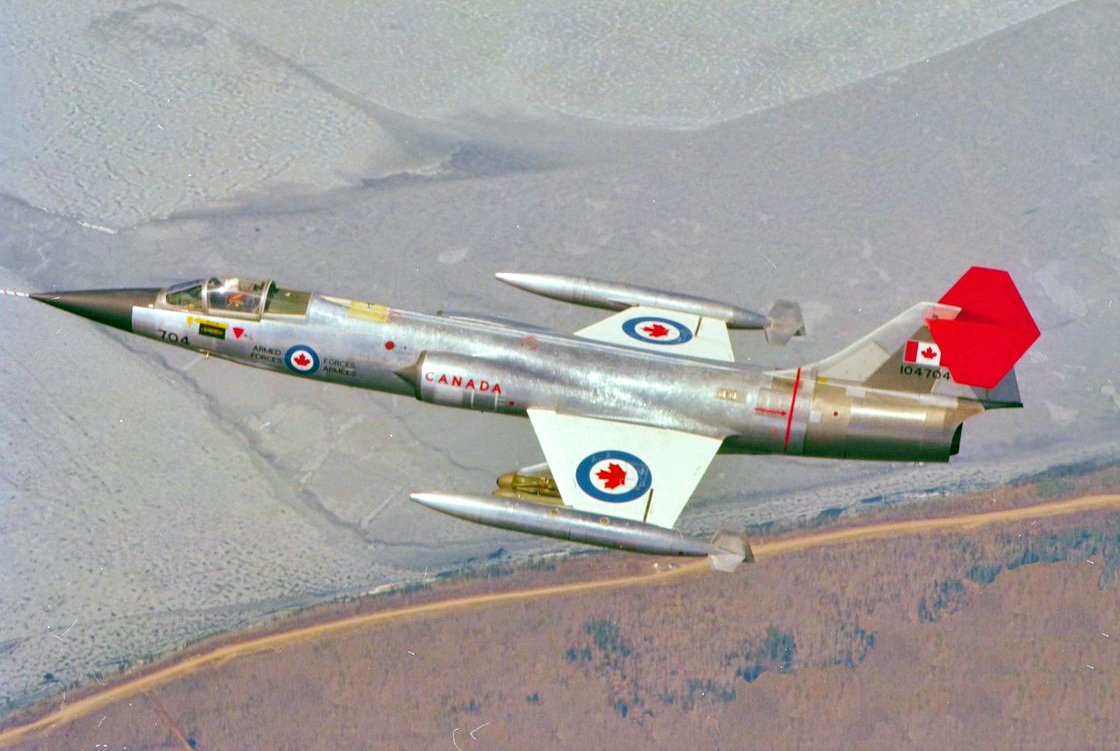
Production and Manufacturer History
The CF-104 was produced under license by Canadair Ltd. at their facility in Cartierville, Quebec. Following the aircraft's selection on July 2, 1959, production commenced, with the first Canadian-built airframe (serial number 12701) completing its maiden flight on May 26, 1961. A total of 200 CF-104 airframes were manufactured for the RCAF, with deliveries of two-seat CF-104D trainers beginning in late 1961. While the exact final year of factory production is not explicitly documented, the production run is described as a short period confined to the early 1960s.
Canadair Ltd. was founded in 1944 and later became a division of General Dynamics. In 1976, the Government of Canada acquired the company, which was subsequently purchased by Bombardier Inc. in 1986. Although the Canadair name is no longer used as a standalone manufacturer, its corporate lineage continues through Bombardier Aerospace.
Design and Technical Specifications
The fundamental design of the CF-104 was led by Clarence “Kelly” Johnson and the Lockheed Skunk Works. The aircraft is characterized by its extreme configuration, featuring very small, mid-mounted trapezoidal wings designed to minimize drag at high speeds. This design allowed the F-104 family to set multiple world records, including a speed of approximately 1,404 mph and altitude records of 91,240 ft and 103,395 ft, with an unofficial altitude of 120,800 ft.
The CF-104 was powered by the Orenda J79-OEL-7, a license-built version of the General Electric J79 turbojet produced by Orenda Engines Ltd. This engine was capable of producing 15,800 pounds of thrust with the afterburner.
Military Service and Legacy
Selected to replace the Sabre Mk.6 in Europe, the CF-104 entered Canadian service in March 1962. Its primary roles were nuclear strike and photo reconnaissance under NATO, utilizing U.S.-supplied B28, B43, and B57 bombs. In 1971, the aircraft's role was converted to conventional ground attack, employing CRV-7 rockets and Mk 82 500 lb bombs.
Canadian service continued until early 1986, when the aircraft were replaced by the McDonnell Douglas CF-18 Hornet. Beyond Canada, 44 CF-104s and 6 CF-104Ds were transferred to the Turkish Air Force, where they served until 1994 and flew NATO missions during the 1990 Gulf War. Additionally, the Royal Danish Air Force operated ex-Canadian CF-104s, as evidenced by the sale of serial 12703 in 1972.