
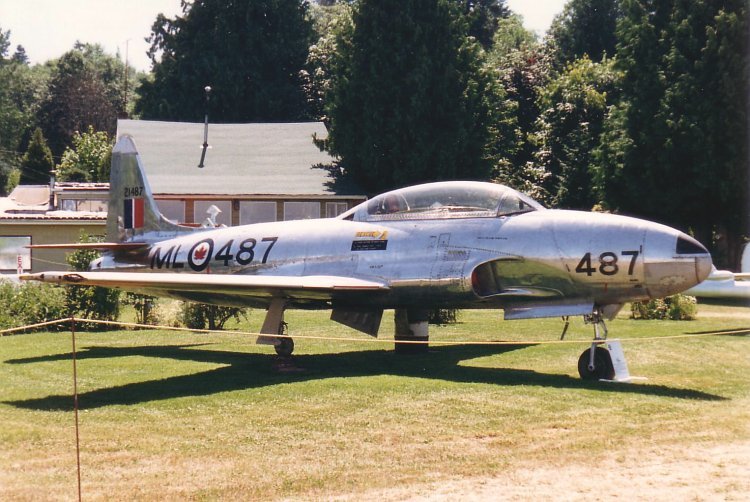
The Canadair CT-133 Silver Star was developed as a license-built derivative of the Lockheed T-33 Shooting Star, which itself evolved from the Lockheed P-80/F-80 family. Following a 1951 contract to provide trainers for the Royal Canadian Air Force, Canadair began production of the aircraft in Canada. The CT-133 first flew in December 1952, marking the start of a production run that lasted until 1959, resulting in a total of 656 aircraft built.
Technically, the CT-133 differed from the original American T-33 primarily through its powerplant. While the U.S. version utilized the Allison J33, the Canadian-built Silver Star was powered by a single Rolls-Royce Nene 10 turbojet, capable of producing 22 kN (5,000 lbf) of thrust. The aircraft featured a crew capacity of one to two personnel, a length of 11.48 meters, and a wingspan of 12.93 meters. With a maximum takeoff weight of 7,630 kg, the CT-133 could reach a maximum speed of 920 km/h and operate at a service ceiling of 14,000 meters.
In military service, the CT-133 was utilized extensively by the Royal Canadian Air Force, the Canadian Forces, the Royal Canadian Navy, and the National Research Council. While its primary role was as a trainer for interceptor and fighter pilots, the aircraft's versatility allowed it to be used for communication flights, target towing, enemy simulation, and as the platform for the Red Knight aerobatic display team. Beyond Canada, the aircraft saw service in several other nations, including France, Greece, Portugal, Turkey, and Bolivia.
The Silver Star is most notable for its extraordinary longevity in Canadian service. Although its primary role as a trainer ended in 1976, the type remained in the Canadian Forces inventory until 2005. As late as 1995, over 50 aircraft remained in service. The final Canadian example served as an ejection-seat testbed for the Aerospace Engineering Test Establishment at CFB Cold Lake before being sold as surplus. Following their military retirement, some airframes entered the civil register.