
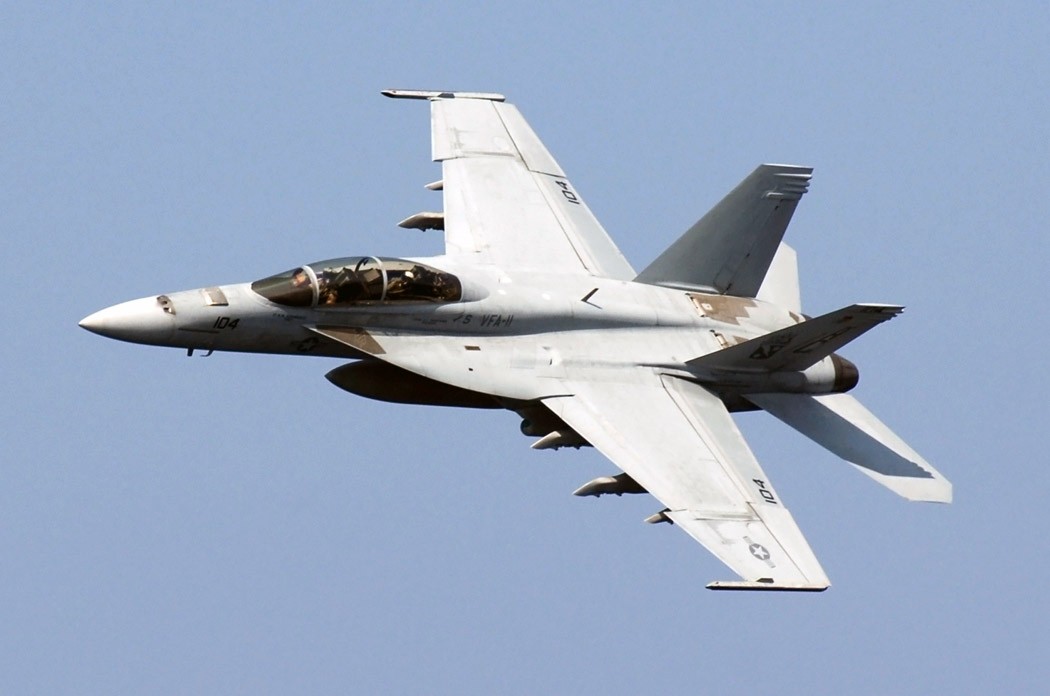
Naval Aviation Dominance
The F/A-18E Super Hornet transformed U.S. Navy carrier operations by providing unmatched versatility in a single airframe. Unlike its predecessors that specialized in specific roles, the Super Hornet seamlessly transitions between air superiority, ground attack, reconnaissance, and aerial refueling missions during the same sortie. This multirole capability allowed the Navy to reduce the variety of aircraft types aboard carriers while maintaining operational effectiveness.
Combat Proven Performance
The Super Hornet earned its combat credentials early, participating in Operation Southern Watch over Iraq beginning in 2002. On November 6, 2002, two F/A-18Es from Strike Fighter Squadron VFA-115 conducted the type's first combat strikes, destroying surface-to-air missile launchers at Al Kut and a command bunker at Tallil Airbase. The aircraft has since served extensively throughout the Global War on Terror, the 2003 Iraq War, and continuing Middle East operations, demonstrating remarkable reliability in harsh combat environments.
The Super Hornet family includes three primary variants: the single-seat F/A-18E, the two-seat F/A-18F, and the specialized EA-18G Growler electronic warfare variant. This configuration flexibility allows squadron commanders to tailor their force structure to specific mission requirements while maintaining commonality in maintenance and pilot training.
McDonnell Douglas Legacy
McDonnell Douglas, formed in 1967 through the merger of McDonnell Aircraft and Douglas Aircraft, designed the Super Hornet as their final major military aircraft program. The company brought decades of fighter experience to the project, having previously created legendary aircraft including the F-4 Phantom II and the original F/A-18 Hornet in partnership with Northrop. When Boeing acquired McDonnell Douglas in August 1997, production seamlessly transitioned to Boeing's St. Louis facility, where manufacturing continues today with production scheduled to conclude in 2027.
The Super Hornet emerged from the Navy's VFAX program, championed by Vice Admiral Kent Lee despite opposition from senior officers like Vice Admiral William D. Houser who preferred alternative solutions. Lee's vision called for a larger, more capable derivative of the original Hornet that could replace multiple aging aircraft types including the A-4 Skyhawk, A-7 Corsair II, and complement the F-14 Tomcat.
Advanced Propulsion and Design
Powering the Super Hornet are two General Electric F414-GE-400 turbofan engines, each producing 22,000 pounds of thrust with afterburner. These engines, evolved from the F404 powerplants of the original Hornet, feature advanced digital controls that improve fuel efficiency and reduce maintenance requirements—critical factors for extended carrier deployments. The F414's reliability record has proven exceptional in the demanding environment of carrier operations, where engines must withstand catapult launches and arrested landings.
Key design innovations include an enlarged airframe that increased internal fuel capacity by 33 percent compared to the legacy Hornet, significantly extending range and loiter time. Engineers incorporated stealth features to reduce radar cross-section, conformal fuel tanks for extended range missions, and advanced avionics that allow a single pilot to manage complex multirole missions effectively.
Pilot and Operator Perspective
Navy pilots praise the Super Hornet's forgiving handling characteristics and exceptional visibility from the cockpit. The aircraft maintains stable flight characteristics throughout its performance envelope, from carrier approach speeds around 135 knots to supersonic dash speeds exceeding Mach 1.6. Its service ceiling above 50,000 feet and combat radius of more than 1,275 nautical miles provide commanders with tactical flexibility unavailable in shorter-range aircraft.
The twin-engine configuration offers pilots confidence during single-engine operations, particularly crucial during night carrier operations. The aircraft's 20mm M61 Vulcan cannon and nine hardpoints can accommodate the full spectrum of modern air-to-air and air-to-surface weapons, including AIM-120 AMRAAM missiles, precision-guided bombs, and external fuel tanks for extended missions.
International Success and Legacy
Beyond U.S. Navy service, the Super Hornet has found international success with the Royal Australian Air Force and Kuwait Air Force, validating its design excellence. Australia's selection of the Super Hornet demonstrated the aircraft's adaptability to land-based operations while maintaining its carrier heritage.
With approximately 500 Super Hornets remaining in active U.S. Navy service as of 2025, the type continues serving as the primary strike fighter while the service gradually introduces the F-35C Lightning II. The Super Hornet's 26-year production run represents one of the longest continuous fighter manufacturing programs in aviation history, testament to its enduring relevance in modern naval aviation. As production concludes in 2027, the Super Hornet will have secured its place as one of the most successful carrier-based fighters ever built, bridging the gap between Cold War-era aircraft and fifth-generation stealth fighters.