
Service Dominance
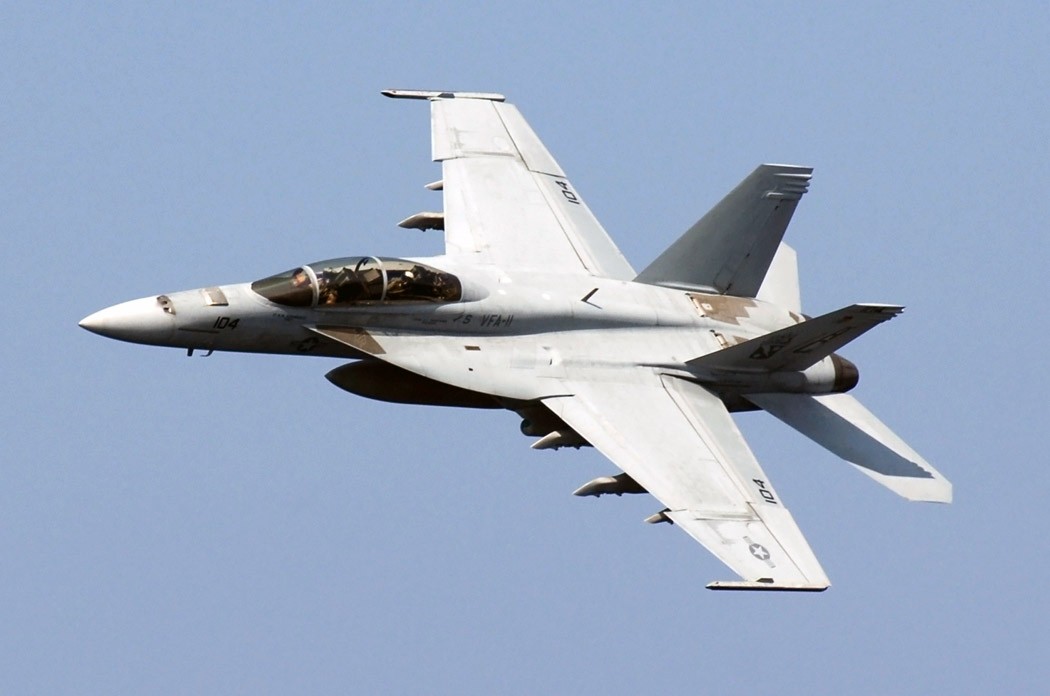
The F/A-18F Super Hornet established itself as the premier naval strike fighter following its entry into fleet service in 1999. By 2001, when the aircraft achieved initial operating capability, it had begun replacing the aging F-14 Tomcat in carrier air wings worldwide. The dual-seat F variant brought enhanced mission capacity through shared workload distribution, allowing one crew member to focus on flying while the other managed complex weapons systems and sensors.
Combat Operations
The Super Hornet proved its combat effectiveness on November 6, 2002, when two F/A-18Es from Strike Fighter Squadron 115 conducted precision strikes against Iraqi surface-to-air missile sites at Al Kut and an air defense bunker at Tallil Airbase during Operation Southern Watch. This marked the first real-world combat test of the aircraft's advanced systems. Throughout Operations Iraqi Freedom and Enduring Freedom, Super Hornets demonstrated their versatility across the full spectrum of naval aviation missions, from air superiority to close air support.
The aircraft's 11 weapons stations accommodate more than 400 different loadout configurations, enabling it to perform air-to-air combat, air-to-ground strikes, intelligence gathering, aerial refueling, and suppression of enemy air defenses within a single sortie profile.
Manufacturing Heritage
McDonnell Douglas served as prime contractor for the Super Hornet program, with Northrop Corporation producing the aircraft's rear fuselage sections while McDonnell Douglas manufactured the forward sections and conducted final assembly. This partnership arrangement continued the successful collaboration established during original Hornet production.
Following Boeing's acquisition of McDonnell Douglas in 1997, the Super Hornet program transitioned to Boeing Defense, Space & Security. Production began at low rates in early 1997, escalating to full-rate production by September of the same year. The program maintained continuous production for nearly three decades, with manufacturing scheduled to conclude in 2027.
Technical Innovation
The F/A-18F incorporated groundbreaking flight control technology, becoming the first production fighter equipped with a fully digital fly-by-wire system featuring quadruple redundancy. This advancement provided unprecedented flight stability and control precision, particularly critical during carrier operations. Engineers designed the airframe structure for a 6,000-flight-hour service life, significantly exceeding earlier naval fighters.
The twin-engine configuration provided essential safety margins for over-water operations, while the outward-canted engine installation optimized airflow characteristics during high-angle-of-attack maneuvering.
Pilot Operations
Naval aviators praised the F/A-18F for its predictable handling characteristics and advanced avionics integration. The dual-seat configuration proved particularly valuable for training new pilots and managing complex strike missions in contested airspace. The aircraft's digital systems reduced pilot workload while providing enhanced situational awareness through integrated sensor displays.
The U.S. Navy Blue Angels Flight Demonstration Squadron selected the Super Hornet in 2020, replacing their legacy Hornets and showcasing the aircraft's precision flight capabilities to millions of spectators annually.
International Success
Beyond American service, the Super Hornet family attracted seven international operators: Canada, Australia, Finland, Kuwait, Malaysia, Spain, and Switzerland. This international adoption validated the aircraft's design excellence and operational effectiveness across diverse mission requirements and environmental conditions.
Production Legacy
The final F/A-18E/F Block II production aircraft rolled off the assembly line in April 2020, marking the end of the initial production configuration. However, Boeing continues manufacturing updated variants with enhanced capabilities, maintaining the program through its planned 2027 conclusion.
The F/A-18F Super Hornet's quarter-century service record demonstrates its enduring value as a multirole naval fighter. Its combination of advanced systems, operational flexibility, and proven combat effectiveness established new standards for carrier-based aviation that continue influencing modern fighter design philosophy.