
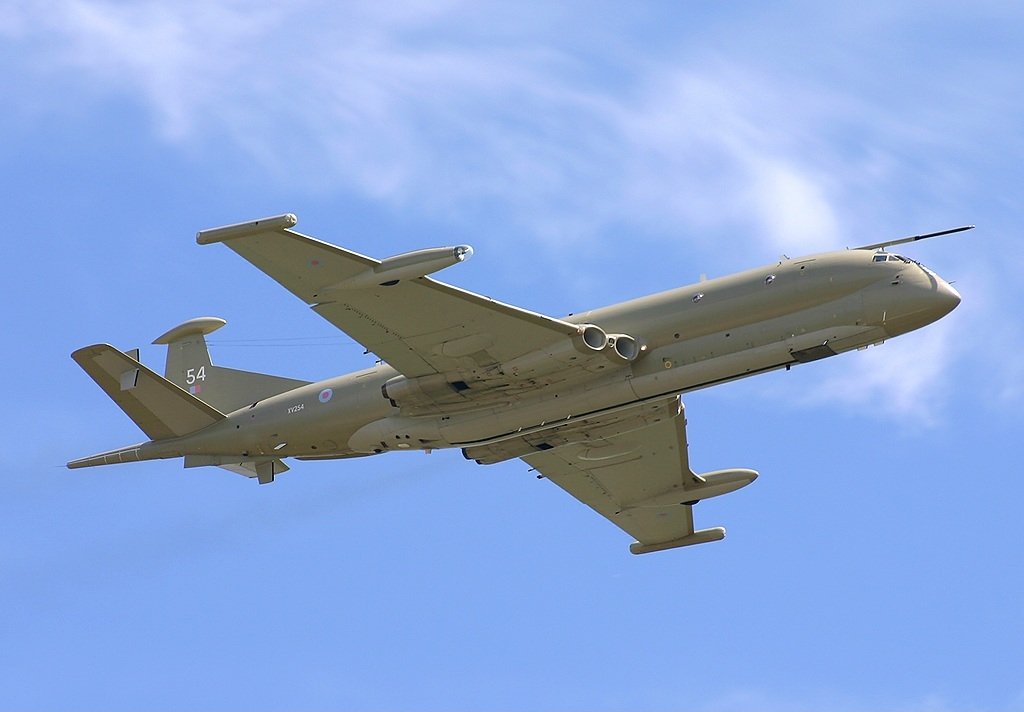
Production and Manufacturer History
The Hawker Siddeley Nimrod was originally designed and produced by Hawker Siddeley, utilizing the airframe of the de Havilland DH.106 Comet 4. The aircraft's development was a collaborative effort that continued through British Aerospace and eventually BAE Systems. Production was centered at Hawker Siddeley's Broughton plant in the United Kingdom, where Comet 4C airframes were converted into the Nimrod configuration. A total of 51 airframes were built, consisting of two prototypes and 49 production aircraft. While the first production Nimrod MR.1 (XV230) was delivered in October 1969, the exact end date of production is not documented in available records.
Design and Technical Specifications
Developed to meet Royal Air Force (RAF) Air Staff Requirement 381 issued on 4 June 1964, the Nimrod was intended to replace the piston-engined Avro Shackleton. The aircraft first flew on 23 May 1967. It was powered by four Rolls-Royce Spey low-bypass turbofan engines, each producing 12,160 lbf of thrust. The MR.2 variant featured a crew of 13 and could reach a maximum speed of approximately 580 mph, with a cruise speed of 490 mph and a service ceiling of nearly 44,000 ft. Its range varied between 5,180 and 5,755 nautical miles depending on the configuration. For combat, the MR.2 utilized an internal weapons bay and two underwing pylons to carry up to 20,000 lb of stores, including depth charges, naval mines, torpedoes, and missiles.
Military Service
Operated exclusively by the RAF, the Nimrod entered service on 2 October 1969. The MR.1 was the initial maritime reconnaissance variant, while the MR.2 provided upgraded sensors and avionics; 35 MR.1s were converted to the MR.2 standard starting in 1975. A specialized signals-intelligence variant, the Nimrod R.1, was operated by No. 51 Squadron. During the Cold War, the fleet monitored Soviet submarine activity from bases such as RAF Kinloss and RAF St Mawgan. During the 1982 Falklands War, MR.2s flew 111 missions from Ascension Island, acting as escorts for "Black Buck" raids and utilizing air-to-air refueling probes and AIM-9 Sidewinder missiles for self-defense. The aircraft also served in the 1991 Gulf War and conducted ISR missions in Afghanistan, Iraq, and the Balkans. A significant tragedy occurred on 2 September 2006, when XV230 crashed over Afghanistan, resulting in the loss of 14 personnel.
Legacy
The Nimrod was retired from RAF service in June 2011, with the MR.2 variant concluding its service in March 2010 and the R.1 following in June 2011. It is remembered as a pioneer in jet-powered maritime patrol, bridging the gap between civil airliner technology and specialized military surveillance. Today, eight Nimrods are preserved on public display within the United Kingdom.