
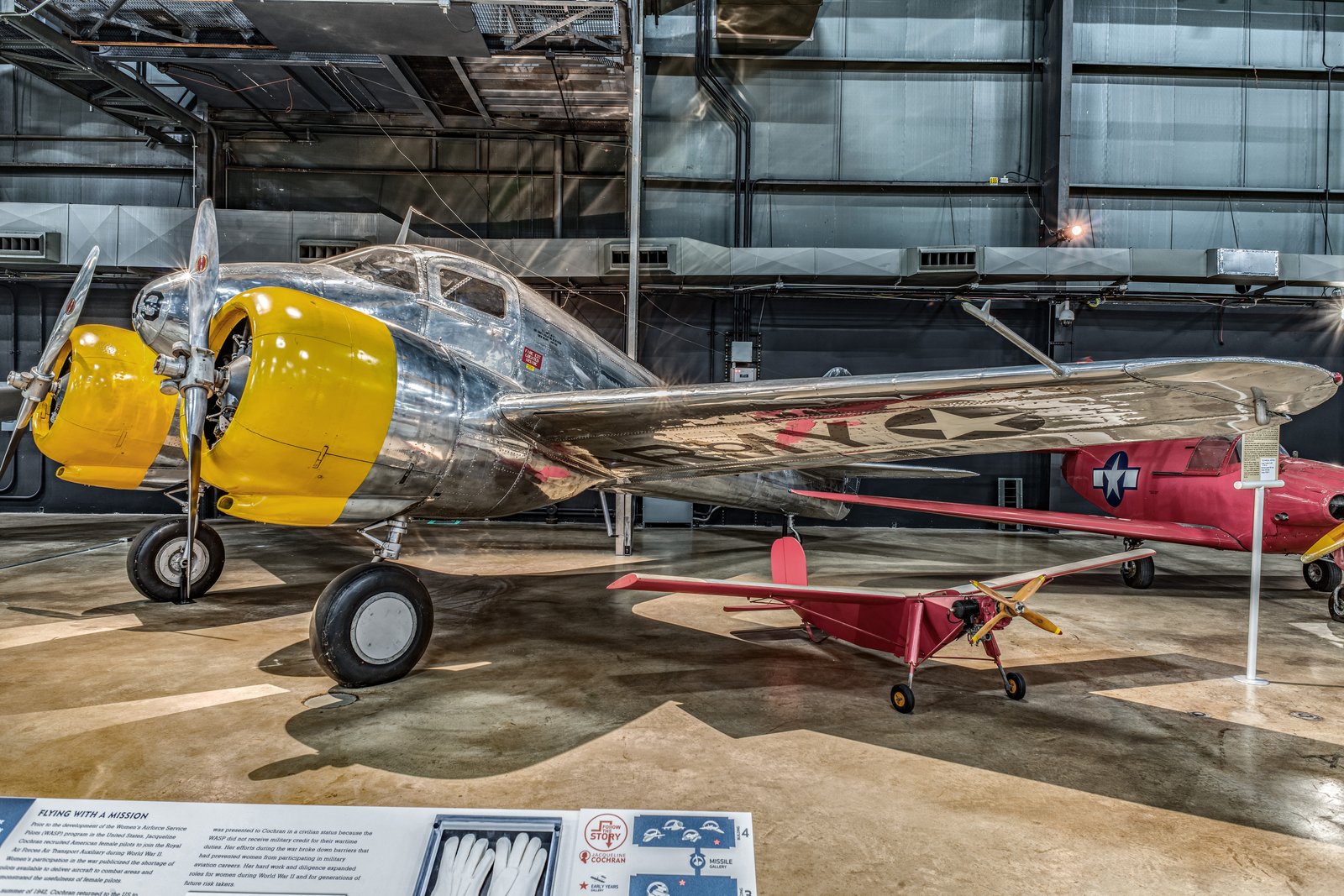
The Curtiss-Wright AT-9, widely known by its service nickname "Jeep" and originally called the "Fledgling," was an advanced twin-engine trainer utilized by the United States Army Air Forces (USAAF) during World War II. The aircraft was specifically designed to serve as a transitional "bridge" for pilots moving from forgiving single-engine trainers to high-performance, demanding multi-engine combat aircraft, most notably the Lockheed P-38 Lightning and the Martin B-26 Marauder.
Production began with the prototype CW-25 (Model 25), which first flew in 1941. While the prototype featured a fabric-covered steel-tube fuselage and fabric-covered wings and tail, the production AT-9 and AT-9A models transitioned to an all-metal stressed-skin construction. The aircraft featured a low-wing cantilever monoplane configuration and retractable landing gear. A total of 791 airframes were produced between 1941 and February 1943, consisting of 491 AT-9 units and 300 AT-9A units. These were manufactured by Curtiss-Wright, specifically through its St. Louis Airplane Division.
Technically, the AT-9 was powered by two air-cooled, 9-cylinder Lycoming R-680-9 radial piston engines, each producing 295 hp. The later AT-9A variant utilized the Lycoming R-680-11 engine and featured a revised hydraulic system. Performance specifications for the AT-9 included a maximum speed of 197 mph, a cruising speed between 173 and 175 mph, and a service ceiling of 19,000 ft. It possessed a range of 750 miles and could climb to 10,000 ft in 8 minutes and 36 seconds.
In service, the AT-9 gained a reputation for being "twitchy" and difficult to fly and land. This instability was a deliberate design choice to ensure pilots were fully attentive and prepared for the rigors of combat aircraft. Notable personnel associated with the type include comedian George Gobel, who served as an instructor on the AT-9 and B-26 at bases in Oklahoma. The aircraft was also used to train the Women Airforce Service Pilots (WASP), and records indicate at least one aircraft was based at Lubbock Army Air Field, Texas, between 1942 and 1943.
Due to its challenging handling and accident record, the AT-9 was not released as surplus to the civilian market after the war. Most airframes were ordered to be scrapped, though some were kept as non-airworthy ground trainers. Today, only two reconstructed examples survive as static museum displays: an AT-9 at the National Museum of the United States Air Force and an AT-9A at the Pima Air & Space Museum.