
Production and Manufacturer History
The Hawk 200 was developed during the mid-1980s as a combat-oriented derivative of the existing Hawk trainer family. The aircraft's lineage began with Hawker Siddeley, but by the time the 200 series was developed, the company had been absorbed into British Aerospace (BAe) following the 1977 nationalization of the UK aerospace industry. Production was carried out in the United Kingdom, with assembly occurring at BAE Systems' Brough facility, though other sites such as Kingston, Dunsfold, and Warton were also involved in the broader Hawk program. In 1999, British Aerospace merged to become BAE Systems, which continued as the manufacturer through 2022.
Design and Technical Specifications
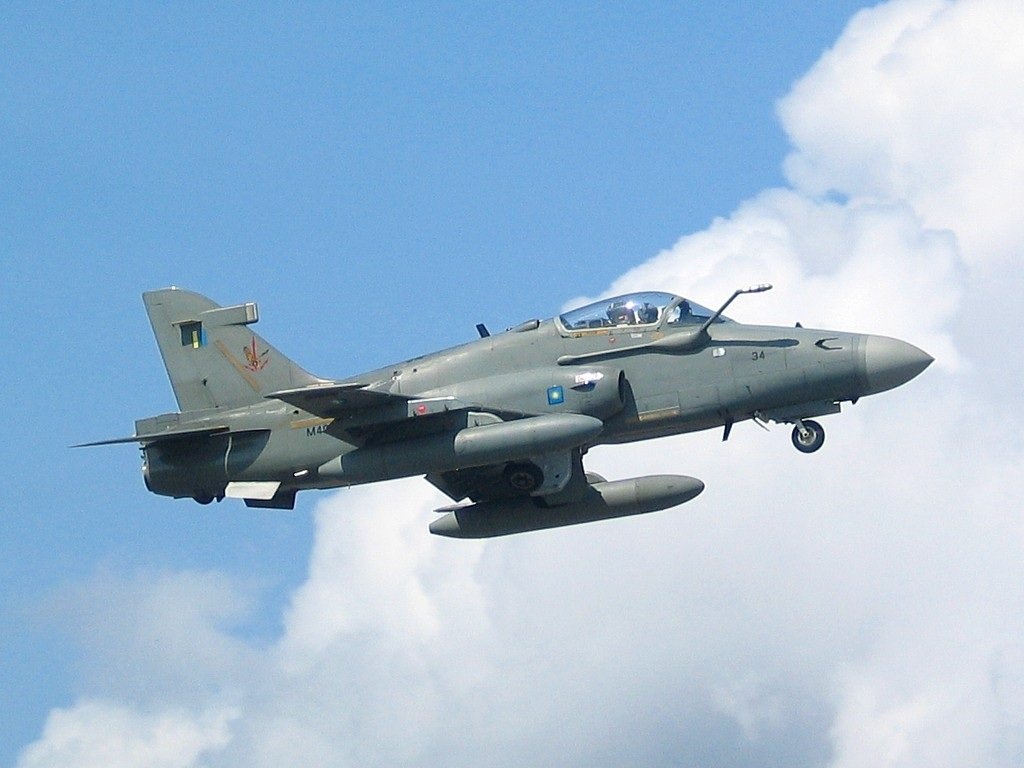
Designed under the leadership of Ralph Hooper, the Hawk 200 is the only single-seat variant within the Hawk family. To transform the trainer into a light fighter, the airframe underwent several modifications, most notably a redesigned, wider, and more pointed nose to accommodate the Northrop Grumman AN/APG-66H radar. Additionally, the canopy was shortened to reflect the removal of the second cockpit. These changes, combined with the trainer's inherent agility and low wing loading, created a platform with a small visual and infrared signature.
Power is provided by a single Rolls-Royce/Turbomeca Adour non-afterburning turbofan engine. While specific thrust ratings for the 200 series are not explicitly detailed, it belongs to the same engine family as the Hawk 100, which utilizes the Adour Mk 871 producing approximately 26.0 kN (5,845 lbf) of thrust.
Military Service and Performance
As a light multirole fighter, the Hawk 200 was designed for a wide array of missions, including air defense, air denial, interdiction, ground attack, and close air support. Its combat capabilities are highlighted by its ability to carry air-to-surface weapons and anti-ship missiles. For example, in a specific configuration carrying two 592-litre external fuel tanks and three BAe Sea Eagle anti-ship missiles, the aircraft achieves a combat range of 617 km (383 mi).
The aircraft was primarily an export success. The Royal Air Force of Oman operates the Hawk 203, the Royal Malaysian Air Force utilizes the Hawk 208, and the Indonesian Air Force employs the Hawk 209. A Hawk 205 variant was proposed for the Royal Saudi Air Force, though it is not recorded as having entered service.
Legacy
The Hawk 200 demonstrates the viability of adapting a cost-effective trainer airframe into a radar-equipped combat aircraft. While the broader Hawk family has seen over 1,000 units sold to 18 different operators, the Hawk 200 remains in front-line service with its primary operators in Oman, Malaysia, and Indonesia.